
Check a Samsung refrigerator’s door seal by separating dirt, obstructed closure, visible damage and cooling performance. Moisture or frost alone does not prove the gasket needs replacing. A short, organized inspection can identify a simple obstruction and give support better information if the problem continues.
Protect food before investigating the door
A door that looks closed does not establish a safe food temperature. FDA storage guidance recommends a refrigerator at or below 40°F (4°C), and a freezer at 0°F (−18°C), checked with appliance thermometers. Refrigerate perishables promptly; generally do not leave them at room temperature beyond two hours, or one hour above 90°F.
If cooling is unsafe, protect perishable food immediately and use official food-safety guidance to assess it. Do not wait for a seal-cleaning experiment or use smell as proof of safety. Our refrigerator temperature measurement guide distinguishes control settings from measured performance.
Separate the symptom from the suspected cause
Write down whether the problem is external condensation, frost near a door edge, a door visibly left ajar, or food freezing inside the fresh-food compartment. These are different observations. Room humidity, frequent openings and other appliance faults can complicate the picture. For overcooling rather than a closure problem, use our Samsung refrigerator freezing-food guide.
In its U.S. frost troubleshooting guidance, Samsung advises checking door closure and blockage, cleaning seals with warm soapy water, drying them, and requesting service for tears or damage. It also warns against using a hair dryer for frost removal. This guide does not recommend heat guns, sharp scraping tools or improvised gasket reshaping.
Make one pass around the seal
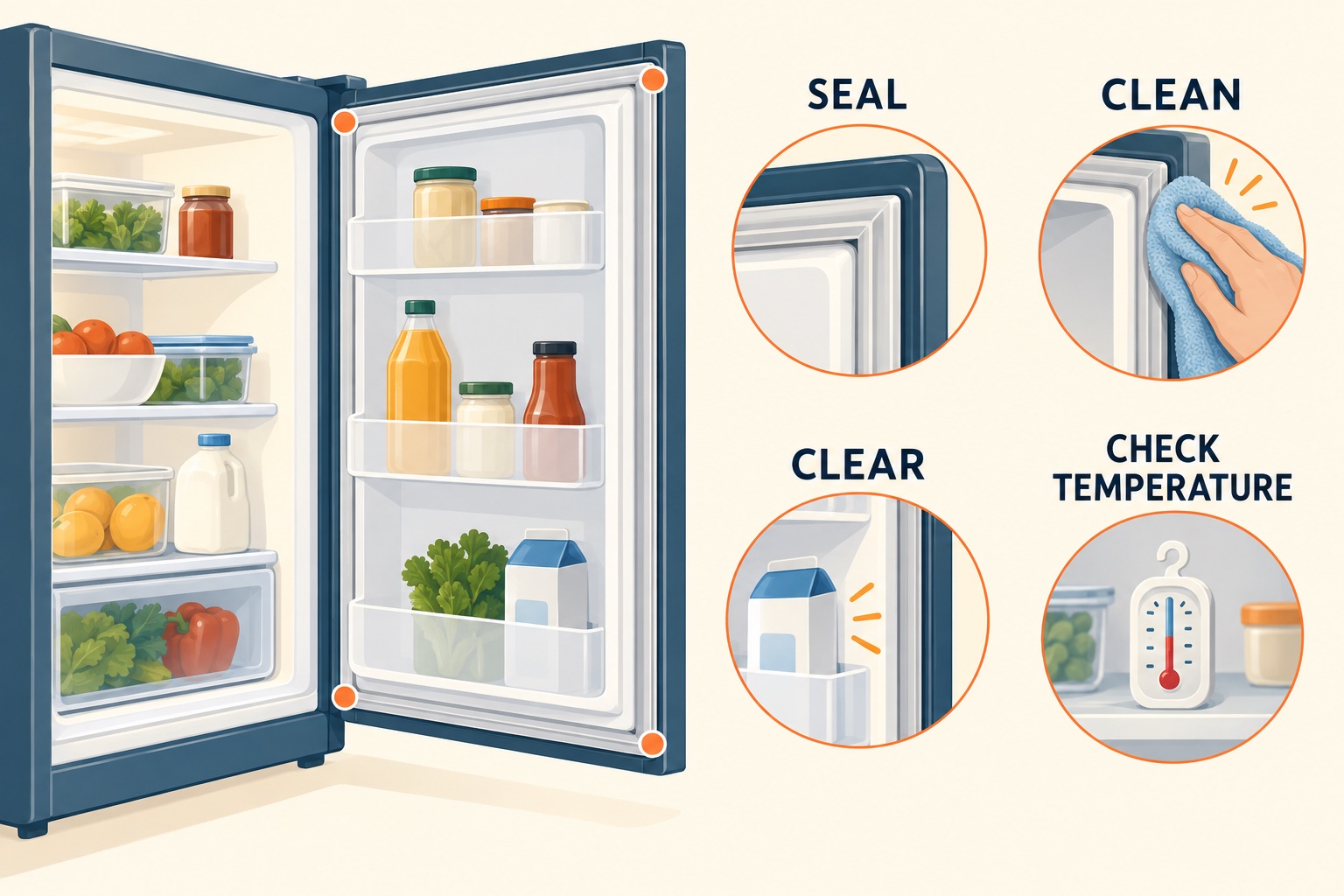
Find the complete model code and open its owner instructions. Inspect an accessible door while minimizing open time; do not remove panels or dismantle hinges. A soft cloth and manufacturer-approved cleaning method are appropriate starting points. Clean gently and dry the surface without pulling the seal away from its mounting.
| Area to record | Observation | Next decision |
|---|---|---|
| Top edge | Sticky residue, gap or visible damage? | Clean residue; document persistent gap |
| Hinge side | Folded seal or interference when closing? | Do not adjust hinges from generic instructions |
| Opposite edge | Package, drawer or shelf blocking closure? | Reposition according to the owner’s manual |
| Bottom edge | Residue, trapped item or torn section? | Clean or clear accessible obstruction; service damage |
Use plain descriptions: “sticky spill at the bottom corner” is more useful than “bad gasket.” Take a photo of visible damage and the model label for support. Keep personal paperwork and unrelated household details out of photos you send.
Check the closure path, not just the rubber
Move protruding packages clear of the door. Confirm shelves and drawers are seated as the model instructions specify. On multi-door refrigerators, an inter-door mechanism may have its own required position; do not force it or apply another model’s instructions. Close the door normally rather than slamming it to overcome resistance.
After correcting an accessible obstruction or cleaning residue, record the change and subsequent door behavior. A briefly successful closure does not validate the entire seal or establish that food remained cold during an earlier gap. Keep temperature monitoring separate from the visual inspection.
When to stop and request service
Ask Samsung or a qualified refrigerator technician about torn seals, persistent visible gaps, doors that will not stay closed, or recurring frost after the basic checks. Give them the model code, affected edge, onset date, photos and temperature record. Do not order a seal solely by the refrigerator’s width or appearance; replacement parts and procedures are model-dependent.
If the problem seems to involve alignment, a damaged hinge or a door that binds, leave structural adjustment to the exact instructions and qualified service. This inspection does not establish whether a fan, defrost component or sensor is functioning.
Editorial method: TemperatureMaster Editorial used AI-assisted research and writing, Samsung support guidance and FDA food-storage advice. The perimeter record is an original organizational aid, not an appliance test or professional inspection. Sources checked October 4, 2026. See our editorial policy.
