
The temperature selected on a refrigerator’s control is not necessarily the temperature of its contents. Use an appropriate appliance thermometer for monitoring, and follow the manufacturer’s specified method when checking cooling performance. Record where, when, and how a reading was taken before comparing it with another number.
This guide separates routine monitoring from a stabilized diagnostic check. If the cabinet is warm, protect perishable food now; do not leave it in unsafe conditions while waiting to complete an appliance test. For the equipment symptom itself, see our running-but-not-cooling guide.
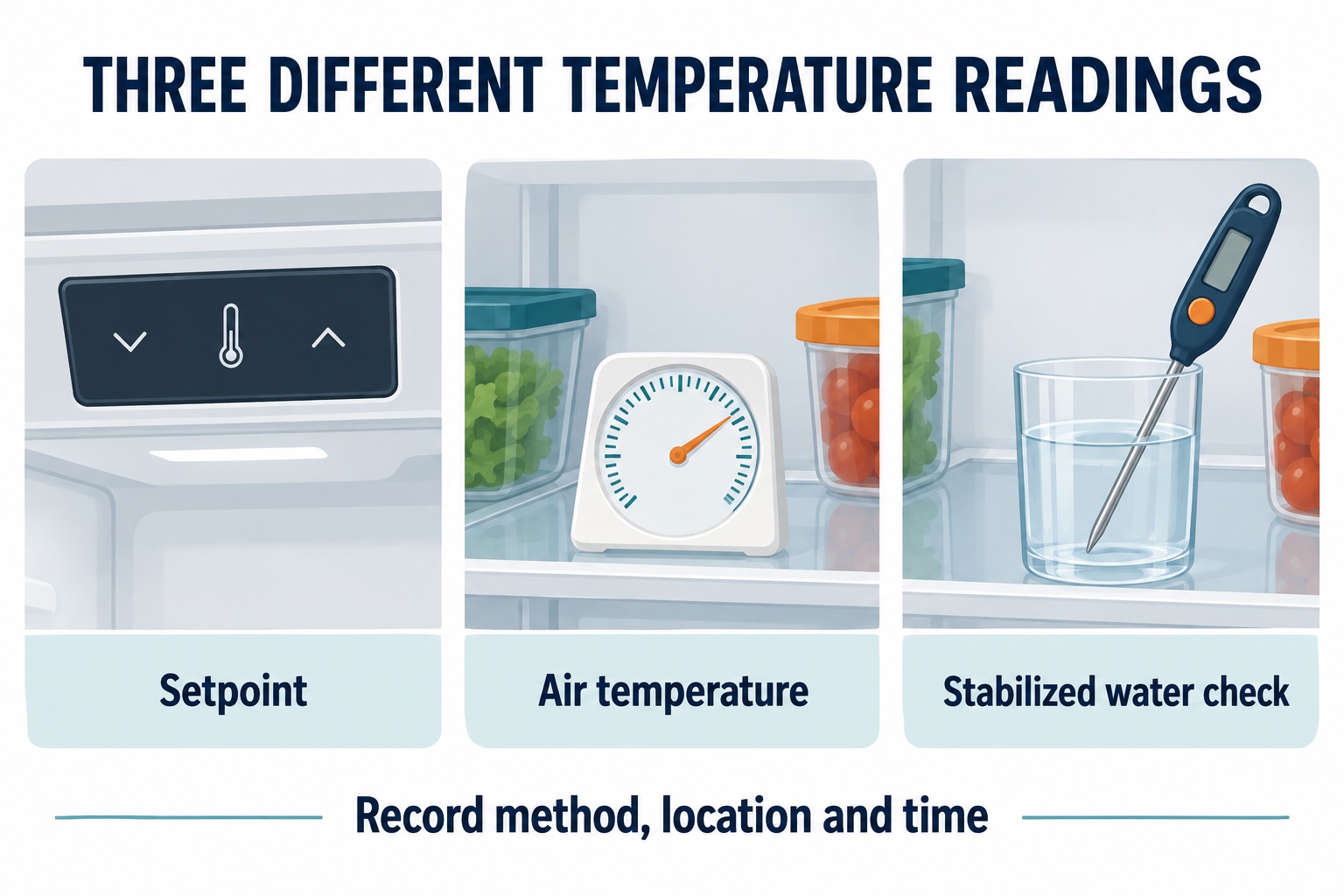
First distinguish the three numbers
| Reading | What it represents | Common comparison mistake |
|---|---|---|
| Control setpoint | The selected target; some models also display an actual temperature | Assuming every illuminated number measures food temperature |
| Appliance thermometer | The reading at its location, with that instrument’s response time | Comparing readings from different shelves or times as if conditions matched |
| Manufacturer-specified stabilized check | A measurement made using a defined medium, location and waiting period | Comparing a brief air change with a stabilized food/liquid result |
Read the display explanation in your owner manual. A control marked with numbers rather than degrees may be a setting scale, not a thermometer. Likewise, a thermometer with a maximum-memory feature needs its own instructions: an unexplained peak does not tell you how long food was above a threshold.
Use food-safety limits independently of appliance settings
The FDA’s food-storage guidance says to keep a refrigerator at or below 40°F (4°C) and a freezer at 0°F (−18°C), and recommends appliance thermometers. It also warns that unsafe food may look or smell normal. Do not taste food to decide whether it is safe.
A recommended appliance setpoint is a control choice, not permission to exceed food-storage limits. If cooling has failed, move perishables to reliable refrigeration or a properly iced cooler while following official food-safety guidance. If you cannot establish how long food was too warm, do not use a later cold reading to declare its earlier storage safe.
For a power interruption, consult the FDA’s linked guidance on outages and food safety. Different foods and exposure histories require different decisions; this temperature worksheet is not a food-specific safety assessment.
GE example: a stabilized check is not a quick air reading
GE’s internal-temperature measurement guidance recommends allowing 24 hours after a control adjustment to stabilize. For its described diagnostic method, it uses a suitable thermometer in food or liquid that has been in the compartment for at least 24 hours, rather than a brief air measurement affected by door openings or defrost.
The same page gives placement guidance that differs for bottom-freezer fresh-food compartments. Use your model’s directions. This is a GE diagnostic example, not a universal instruction for all brands, nor a reason to stop routine appliance-thermometer monitoring.
If a permitted check uses water, use a clean container and an instrument designed for that measurement. Follow its temperature range, immersion limits, and response-time instructions; do not immerse a non-waterproof display or use an unsuitable glass thermometer. Keep the test container separate from food intended for consumption.
A measurement log that keeps unlike readings apart
Copy these fields into a note for yourself or the service appointment. Use one row per reading; avoid putting a setpoint in the column for measured temperature.
| Record | Your entry |
|---|---|
| Brand/model and compartment | ________ |
| Selected setpoint and last change | ________ |
| Thermometer type and stated accuracy | ________ |
| Air, water, or another permitted medium | ________ |
| Shelf/location and placement time | ________ |
| Reading time and measured temperature | ________ |
| Recent door openings, new groceries, or outage | ________ |
| Food-protection action and service request | ________ |
For example, “38°F in stabilized water on the specified shelf” and “an air thermometer briefly showed 43°F after unloading groceries” describe different measurements. These invented numbers do not establish that any food is safe; they show why method and timing belong beside the result.
When readings differ across the cabinet
A measurement applies to its location. The USDA’s refrigeration guidance calls for temperatures of 40°F or below throughout the refrigerator. Do not dismiss persistent warm areas because one shelf is cold.
Without dismantling anything, record visible blocked air outlets, a door that does not close normally, or an unusually packed cabinet. Preserve the manufacturer’s required air space around outlets and storage areas. For Samsung cooling or icing symptoms, our not-cooling guide and freezing-up guide address those separate problems.
GE’s not-cooling-enough support page directs owners toward service when the unit remains warm after its specified stabilization period and appropriate control checks. Contact support sooner for warning signs; do not bypass controls or open electrical/refrigerant components.
About this guide
TemperatureMaster Editorial used AI-assisted research and writing checked against the linked manufacturer, FDA and USDA publications. The log and hypothetical comparison are editorial aids, not appliance-test results or a professional food-safety review. See our editorial policy.
