
You may be able to leave barbecue pellets in a grill hopper between short, dry-weather cooking sessions, but the hopper is not a substitute for long-term airtight storage. The exact grill instructions, expected weather and fuel condition should determine the choice—not a universal number of days.
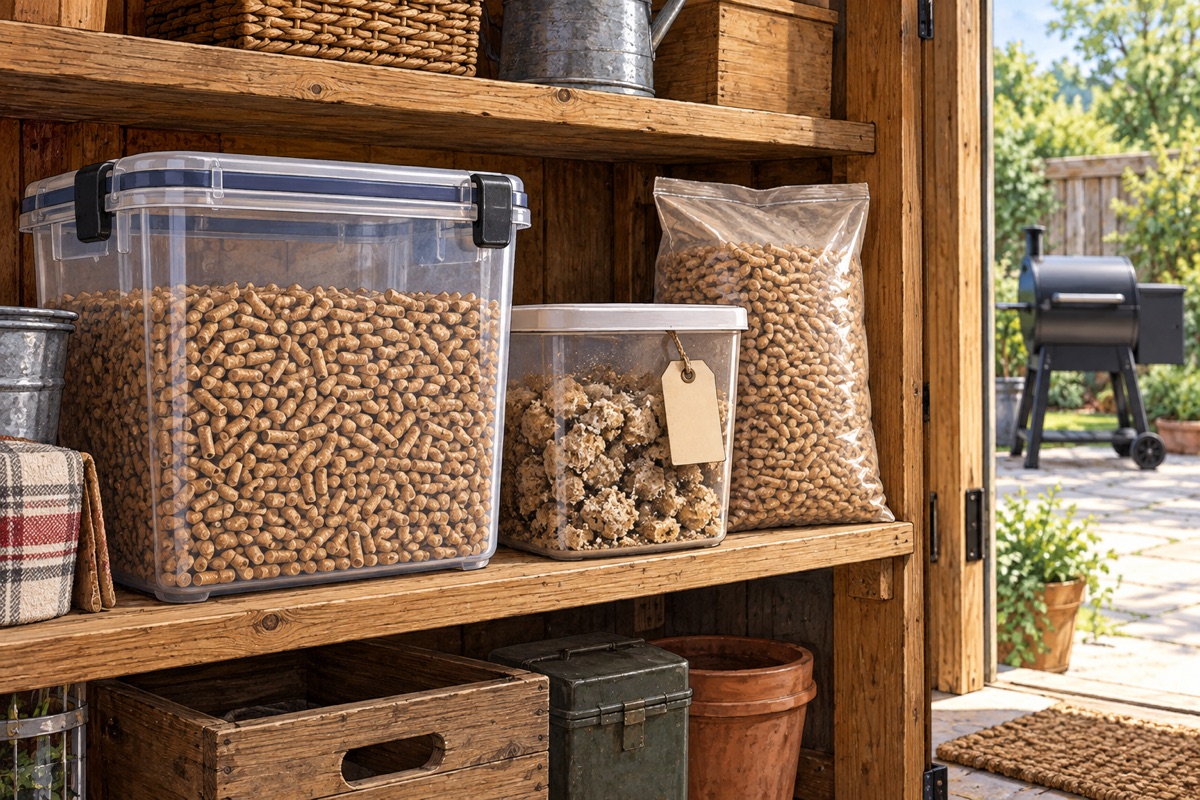
Moisture matters because pellets can swell and crumble. However, finding questionable fuel does not prove that every ignition or temperature problem is a pellet problem. Keep storage decisions separate from repairs to an auger, igniter or controller.
Three situations that call for different decisions
A short gap with reliably dry conditions
Read the model’s storage directions and check whether the grill and hopper are protected as specified. Do not assume a closed lid seals out humidity. Inspect the fuel before the next use, especially after unexpected rain or a spill. Leave the manufacturer’s guards in place and keep hands and tools away from the feed mechanism.
A wet forecast or a long break
Traeger’s storage guidance recommends dry, airtight storage and removing hopper fuel for prolonged rain or high humidity. It also warns that even unopened bags can be affected in humid storage. This is manufacturer guidance for its products, not a tested universal shelf-life claim for every pellet or hopper.
Use the exact grill’s permitted pellet-emptying procedure after normal shutdown and complete cooling, with electrical isolation as instructed. Do not interrupt a required shutdown cycle just to empty the hopper sooner. If access would require removing a guard or reaching into the feed path, stop and ask the manufacturer how to proceed.
Fuel that has already become questionable
Keep suspect stock separate. Adding a fresh bag on top conceals the old material without answering whether it is suitable. Do not grind, bake, microwave or mix wet pellets into dry fuel as a recovery experiment. Obtain the supplier’s advice on affected stock and appropriate disposal; replacing questionable fuel does not authorize repeated failed ignition attempts.
What can you learn from an owner inspection?
Record the bag condition, storage location, signs of water entry, swelling, crumbling or unusual clumps. Traeger describes a clean snap and surface sheen as useful quality clues, while noting that some loose dust can occur normally. These observations are not a moisture assay or a guarantee that fuel will feed and ignite correctly.
A hypothetical bag with a small amount of loose dust and intact pellets is a different observation from a bag with a wet seam and expanded clumps. The second deserves isolation and supplier advice; the first still needs the usual model and fuel checks. Neither observation identifies an electrical fault.
Build a storage routine that preserves the evidence
- Use the barbecue fuel type approved by the grill maker. Heating-stove pellets, wood chips and miscellaneous biomass are not interchangeable with cooking pellets.
- Choose a clean, dry container with a sound sealing lid. Check that it is suitable for the fuel and storage conditions rather than relying on a “weatherproof” sales label.
- Keep the bag identification or record the fuel type, batch information if provided, opening date and any moisture incident.
- Finish one known batch before mixing stock where practical. If a problem appears, separation makes the history easier to explain.
- Check the storage area after a leak or flooding event. Do not treat a lidded bin as proof that its contents remained dry.
Traeger’s fuel guidance distinguishes its cooking pellets from other fuel materials. No particular storage-bin brand is required by this article, and we have not compared or tested bins.
If a cook has already failed, stop the storage experiment
Do not repeatedly restart a grill that has fed pellets without establishing a fire. Accumulated fuel and the failed-start procedure must be addressed according to the model manual. Hopper fire, uncontrolled burning, heavy abnormal smoke or an electrical burning smell calls for the manual’s emergency response, not a fuel-quality test.
Our Pit Boss pellet-grill troubleshooting guide separates power, ignition and sustained-heat symptoms for that brand. For a Traeger or another product, use its own support instructions. Storage records help support evaluate fuel; they do not establish that an auger or hot rod needs replacement.
Editorial method: TemperatureMaster Editorial prepared this research-based guide with AI-assisted research and writing checked against the linked primary publications. Examples and comparison aids are not hands-on test results or a professional diagnosis. Illustration generated with AI. See our editorial policy.
