
On a central forced-air thermostat, the fan setting controls the indoor blower; it does not by itself select cooling or heating. Auto generally lets the equipment control fan operation during calls for heating or cooling. On requests ongoing circulation, and Circulate usually schedules a minimum amount of airflow. Exact behavior depends on the controls and connected equipment.
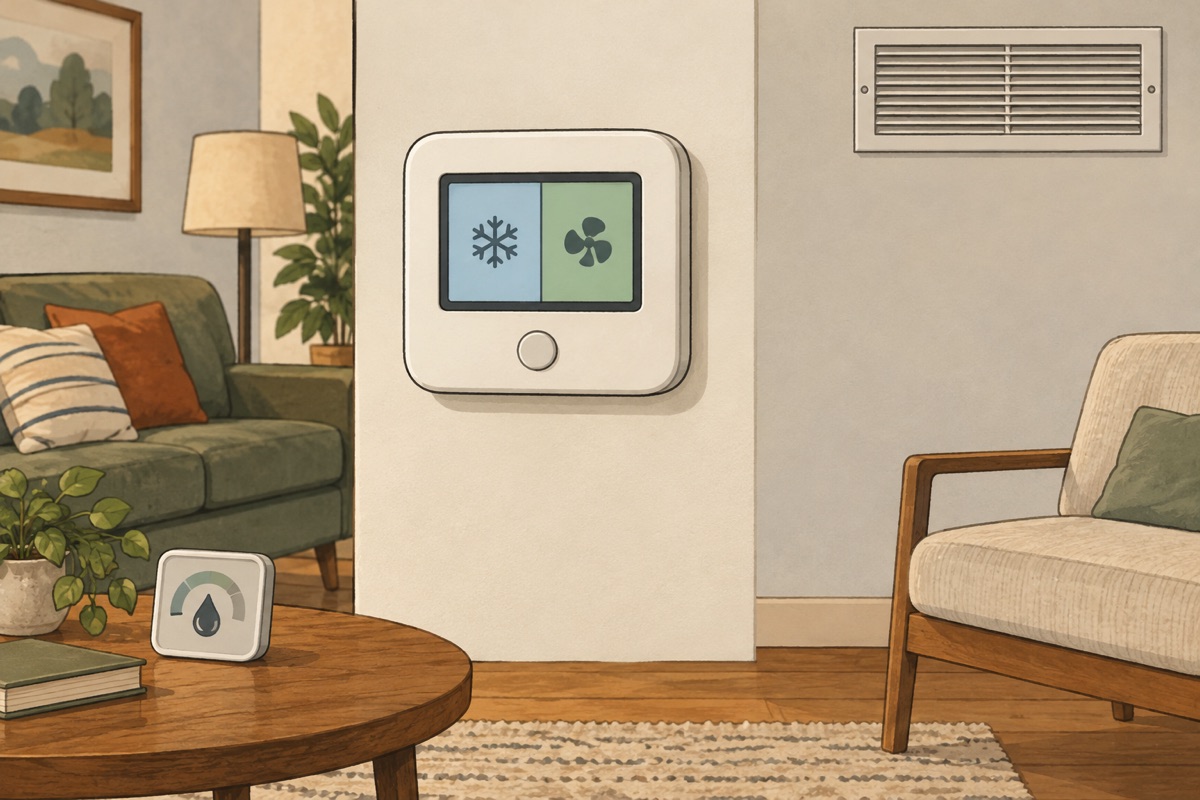
Do not confuse Fan Auto with System Auto. The latter may select between heating and cooling. Also, a room air conditioner’s Fan-only operating mode is not the same setting as a central thermostat’s fan command.
What changes when you change the fan setting?
Moving room air can alter comfort and distribution without actively refrigerating it. A running blower therefore does not prove that the compressor is running, that a room has reached its target, or that moisture is being removed. Look at the system status and relevant readings, not only the sound from a grille.
Trane’s XL824/850/1050 guidance describes Auto, On and Circulate. For those controls, Circulate’s minimum time includes heating/cooling fan runtime; it is not automatically additional runtime on top of it. Treat this as a named example, not a universal programming rule.
Three common situations
You hear airflow after the heating cycle ends
A normal post-cycle delay can continue without a new heat call. Check the model’s normal behavior and fan schedule before assuming a relay has failed. If operation is persistently abnormal, our furnace blower guide separates settings, airflow problems and technician-only faults. Do not disconnect thermostat wires to test the difference.
You want more circulation between cooling calls
Check whether the installed system offers an owner-accessible circulation schedule and what it does with fan speed. Changing circulation is not permission to enter installer menus, alter blower wiring or change commissioning settings. Record the original owner setting so an ordinary comparison can be reversed.
The room is comfortable in temperature but feels damp
Do not assume that continuous fan operation is dehumidification. Some controls deliberately limit off-cycle airflow. The cited Trane guide, for example, describes conditions in cooling mode where On may be overridden to keep humidity low. An apparent pause is not necessarily a fault. Follow the actual system’s humidity-control instructions rather than demanding continuous operation.
Use a room humidity measurement taken away from the supply stream; our hygrometer comparison guide explains placement and uncertainty. Persistent moisture can involve outside air or building sources as well as HVAC operation.
What would extra fan runtime cost?
Use actual fan electrical input, not cooling capacity or the outdoor unit’s nameplate, and only use a meter in an application for which it is approved. Hardwired equipment measurements belong with a qualified professional. A blower’s input can vary with operating speed and system resistance.
For a hypothetical fan drawing 80 watts for six additional hours daily: 80 ÷ 1,000 × 6 × 30 = 14.4 kWh per 30-day month. At an assumed energy charge of $0.20/kWh, that is $2.88. These invented inputs demonstrate the formula; they are not measurements or a forecast of your bill.
Count only additional runtime. If a circulation minimum is already met during cooling calls, charging its entire scheduled period again would double-count. Actual controls, fan power and tariff determine the result.
Make a useful comparison without changing five things
For an otherwise normally operating system, record the fan command, system mode, setpoint, room temperature, humidity, schedule and whether heating/cooling is active. Compare only owner settings permitted by the manual under reasonably similar conditions. One different-weather day is not a controlled efficiency test.
Keep approved filters and unobstructed returns; more fan runtime does not justify fitting a higher-resistance filter. Our filter size and MERV guide addresses that separate compatibility question. Stop ordinary comparisons for gas odor, smoke, electrical burning smells, a CO alarm or repeated protection trips and obtain the appropriate emergency or professional help.
Editorial method: TemperatureMaster Editorial prepared this research-based guide with AI-assisted research and writing checked against the linked primary publications. Examples and comparison aids are not hands-on test results or a professional diagnosis. Illustration generated with AI. See our editorial policy.
