
Pool pump electricity cost depends on actual electrical input, hours in each operating mode, and your electricity tariff—not horsepower alone. Calculate each segment of the schedule separately, add its energy use, then apply the rate for that segment. This worksheet estimates the pump component of a bill; it does not prescribe a filtration schedule.
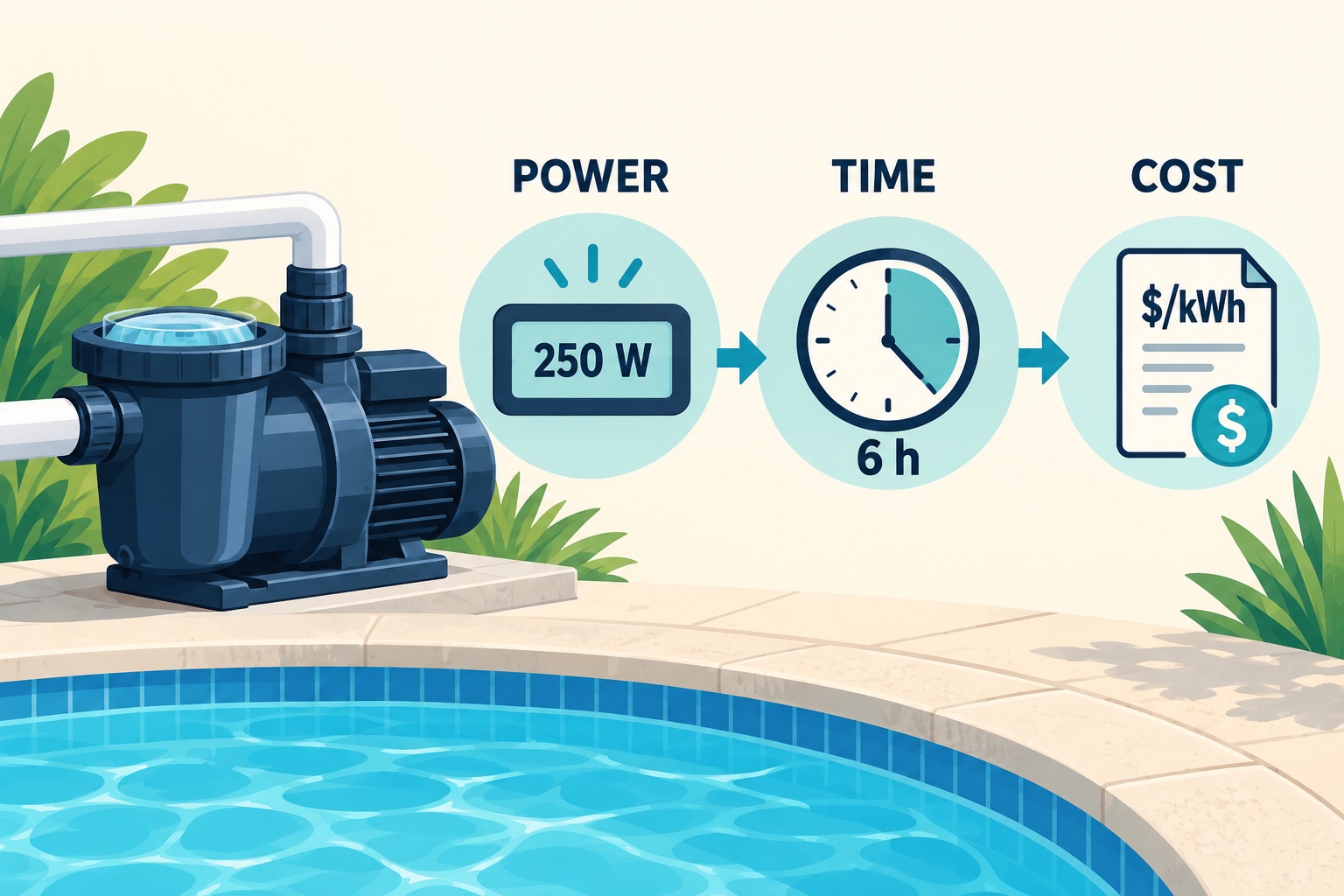
Start with three different numbers
A controller may show speed in RPM and power in watts. Those are not interchangeable. Horsepower describes motor output; a breaker rating describes electrical protection. Neither gives you the actual purchased electricity at a particular speed and plumbing condition. Use the controller’s documented power reading, a compatible monitoring system, or measurements obtained by a qualified professional.
The basic calculation follows Virginia Cooperative Extension’s energy-cost method: watts multiplied by hours, divided by 1,000, equals kilowatt-hours. Multiply kWh by the applicable price per kWh. A displayed wattage is an estimate unless its accuracy is documented.
Do not open electrical enclosures, probe live conductors, or improvise a plug-in meter for a hardwired pool pump. Pool equipment operates around water; measurement and electrical changes need an appropriately qualified professional.
A two-speed schedule worked example
These invented figures illustrate the arithmetic, not recommended speeds or typical electricity prices. Assume 250 W for six hours and 1,200 W for two hours every day, at a flat $0.20/kWh.
| Schedule segment | Calculation | Daily energy |
|---|---|---|
| Lower-power segment | 250 × 6 ÷ 1,000 | 1.50 kWh |
| Higher-power segment | 1,200 × 2 ÷ 1,000 | 2.40 kWh |
| Total | 1.50 + 2.40 | 3.90 kWh |
For 30 identical days: 3.90 × 30 = 117 kWh. Energy charge: 117 × $0.20 = $23.40. Taxes, fixed service charges, demand charges and other equipment are not included. Notice that the two-hour segment uses more energy than the six-hour segment: runtime alone would have hidden that distinction.
Build your own operating record
| Record | What to enter |
|---|---|
| Equipment and setting | Exact model, operating task, RPM or selected program |
| Electrical input | Documented watts or kW; note where the figure came from |
| Time | Actual hours in that mode, including priming and overrides |
| Tariff | Price applying during those hours, including any peak period |
| Uncertainty | Estimated runtime, fluctuating power, missing readings |
Use a representative week rather than one unusually quiet day. A cleaner program, heater flow requirement or manually activated water feature may alter both power and hours. If your meter reports cumulative kWh for this pump, the difference between two readings can be more useful than a single momentary wattage—provided you know exactly which loads the meter includes.
Compare schedules without compromising the pool
Australian government pool-pump guidance explains why multiple speeds let owners match operation to different tasks. Lower speed is not permission to reduce flow below the requirements of a heater, chlorinator, filter, skimmer or other attached equipment. Have the whole system’s needs confirmed before changing its schedule.
For a proposed schedule, keep a second worksheet beside the current one. For example, increasing the six-hour segment from 250 to 350 W adds 0.60 kWh/day. At the example rate, that adds $3.60 over 30 days. This is a sensitivity calculation, not evidence that either setting is suitable for your pool.
For equipment selection, our inground pool pump comparison addresses hydraulic fit and performance curves. For changing resistance as a filter loads up, keep a clean-filter pressure baseline. Neither a low electricity bill nor a pressure reading alone proves adequate circulation or sanitation.
Check the estimate against the bill
Compare like periods and record weather, pool use, heater operation and household changes. A lower whole-house bill does not isolate pump savings. For time-of-use billing, price each segment at its own rate instead of applying the cheapest overnight price to the entire day. If your plan includes demand charges, this energy-only worksheet cannot calculate the whole incremental bill.
Editorial method: Prepared by TemperatureMaster Editorial with AI-assisted research and writing. The example and worksheets are editorial calculations, not measured pump performance or professional sizing advice. Sources were checked October 4, 2026. See our editorial policy.
