
Compare pool heater costs for the same amount of heat delivered to the water, not just the same hour of runtime. A gas heater’s fuel input, a heat pump’s heat output and a resistance heater’s electrical input are different quantities. This guide turns them into a common cost worksheet without promising a universal cheapest heater.
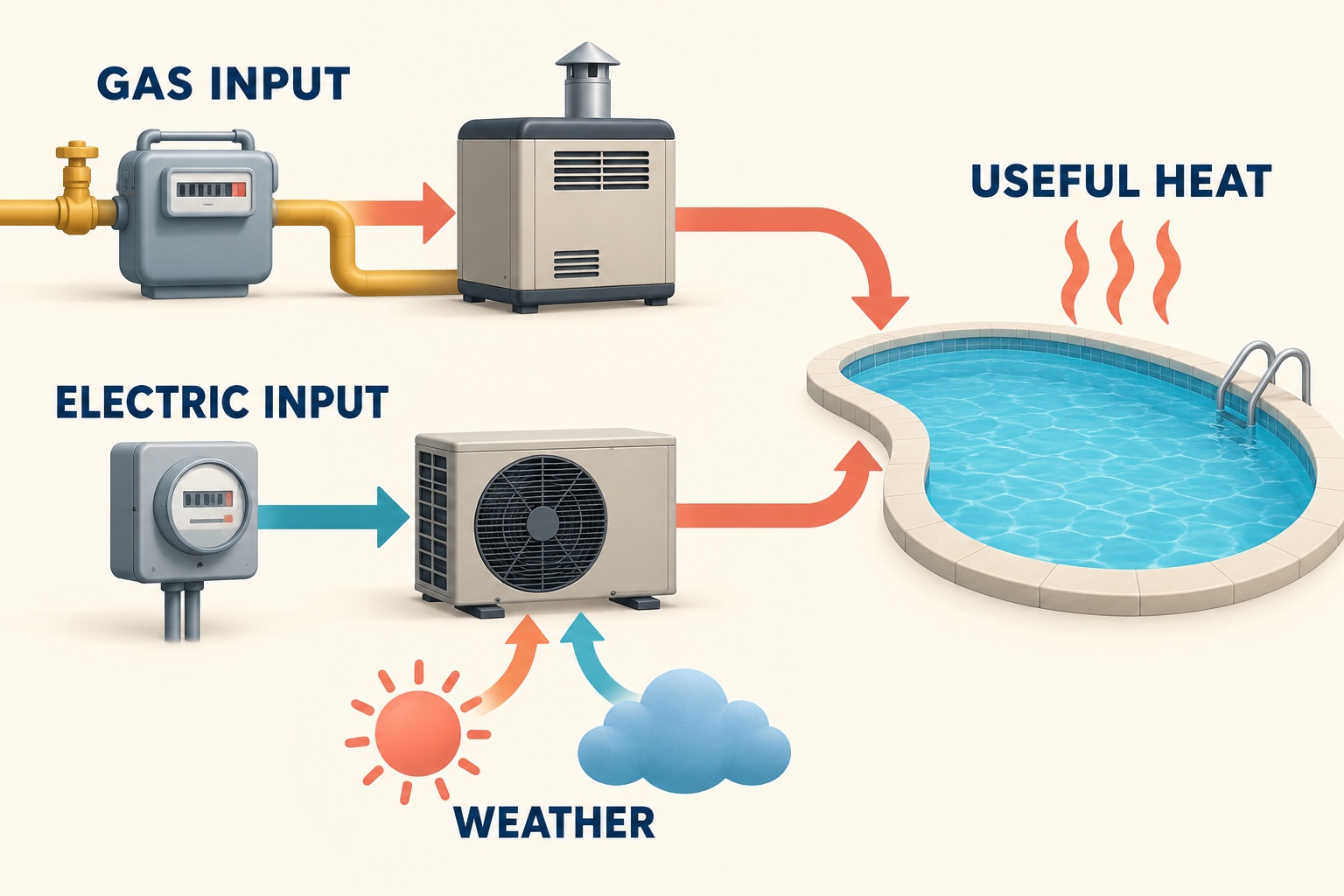
Identify the unit before doing arithmetic
Write down the exact model and whether each specification says input or output. Use the U.S. Energy Information Administration’s conversions: one therm equals 100,000 Btu and one kWh equals approximately 3,412 Btu. Btu/h is a rate of heat transfer; Btu is an amount. An hour matters only when the rate and operating conditions are known.
| Heater type | Information needed | Common mistake |
|---|---|---|
| Natural gas | Fuel input, thermal efficiency, price per therm | Treating input as useful heat output |
| Heat pump | Output and COP at stated conditions, or measured electrical energy | Using a warm-weather COP for every season |
| Electric resistance | Electrical input and documented delivered efficiency | Assuming it is the same technology as a heat pump |
COP is useful heat output divided by electrical input in matching energy units. It is not a guaranteed year-round multiplier. Manufacturer data may list several conditions; for example, Raypak’s catalog, page 13, has separate heat-pump COP rating columns. Do not confuse minimum circuit ampacity or maximum breaker size with operating consumption.
Compare 100,000 Btu of useful heat
The following rates and efficiencies are hypothetical: electricity $0.20/kWh, natural gas $1.50/therm, gas efficiency 80%, heat-pump COP 5 or 3, and resistance efficiency assumed 100% for illustration. They are not current local prices, product ratings or measured seasonal performance.
| Example | Purchased energy | Energy cost |
|---|---|---|
| Gas at 80% | 100,000 ÷ 0.80 ÷ 100,000 = 1.25 therms | $1.88 |
| Heat pump, COP 5 | 100,000 ÷ (3,412 × 5) = 5.86 kWh | $1.17 |
| Heat pump, COP 3 | 100,000 ÷ (3,412 × 3) = 9.77 kWh | $1.95 |
| Resistance, assumed 100% | 100,000 ÷ 3,412 = 29.31 kWh | $5.86 |
The changed COP reverses the ranking between the example heat pump and gas heater. That is the point of the worksheet: assumptions can change the answer. Costs are rounded only at the end. Actual performance also depends on equipment condition and operation.
Separate an hourly estimate from a seasonal forecast
For gas with documented input of 200,000 Btu/h, full-input fuel use would be two therms per firing hour. At the example gas price, fuel alone would cost $3 per firing hour. Do not apply that figure to every clock hour if the burner cycles. For electricity, use actual kW multiplied by operating hours; a nominal heat-output rating is not electrical kW.
A seasonal estimate needs the pool’s heat demand, not merely heater capacity multiplied by the number of days. Wind, evaporation, water temperature, cover use and swimming schedule affect that demand. Our gas versus electric pool heater guide explains the broader selection trade-offs. Our solar-cover fit guide addresses handling; a solar blanket is not a safety cover and must be removed completely before swimming.
Add costs the simple comparison leaves out
- Extra circulation-pump hours required for heating; count only hours beyond the baseline once.
- Standby energy, associated fans or controls, maintenance and installation.
- Time-of-use electricity, gas delivery charges and applicable taxes.
- Fuel-billing units: CCF or cubic meters require your utility’s conversion; they are not automatically therms.
Use our pool pump electricity worksheet for the circulation component. Keep recurring operating cost separate from purchase and installation cost so the comparison remains understandable.
Questions to take to the installer
Ask which rating conditions best represent your heating season, how many extra pump hours are expected, what flow the heater requires, and whether the design meets your desired warm-up time. Do not alter gas piping, wiring, refrigerant components, safety controls or minimum flow to chase a cheaper estimate. Installation and commissioning belong to qualified professionals following the exact manual and local requirements.
Editorial method: TemperatureMaster Editorial used AI-assisted research and writing. Worked examples are original hypothetical calculations, not product tests, local quotations or a heating-system design. Sources checked October 4, 2026. See our editorial policy.
