
There is no single normal pressure for every pool filter. The useful comparison is your system’s clean-filter reading under the same operating conditions, followed by the cleaning and service criteria in the exact filter manual.
A reading such as 20 psi means little without the filter model, pump speed, and previous baseline. This guide provides a record-keeping method, not instructions to open, adjust, or pressure-test a filter.
Keep observation separate from filter service
Pool filters contain pressurized water and can trap air. Pentair’s filter safety center warns that trapped air can force the lid apart and recommends professional filter maintenance. Do not touch a clamp, loosen a lid, remove a gauge, or change a valve position to investigate a reading.
Read only what is safely visible without leaning over the tank or reaching around closures. A gauge showing zero is not, by itself, proof that equipment is safe to open. If you see leaking or damaged equipment, hear an abnormal noise, or cannot establish safe access, stop the investigation and contact your pool professional.
What belongs in a clean-filter baseline?
Ask your pool professional to record a baseline after the filter has been correctly serviced and the system returned to normal operation. Do not create a “clean” baseline from an unexplained reading on an unfamiliar installation.
For variable-speed pumps, the 2025 Pentair Clean & Clear Plus manual explicitly connects starting pressure to pump RPM and includes a place to record the original speed. A later reading at a different speed is not a like-for-like comparison.
| Record | What to write |
|---|---|
| Equipment | Full filter model and pump model |
| Service event | Date and what the professional completed |
| Baseline | Pressure, displayed units, and pump RPM or speed setting |
| System mode | Pool/spa mode and any active cleaner or water feature |
| Manual criteria | Publication/revision and the model’s cleaning or service instructions |
| Follow-up | Date, pressure, speed, mode, and any change in flow or sound |
The additional mode and equipment fields are our editorial record-keeping recommendation. They help explain what changed without requiring the owner to manipulate plumbing. Leave an unknown field blank and ask the professional rather than treating a guess as a measurement.
Calculate the rise, not just the current number
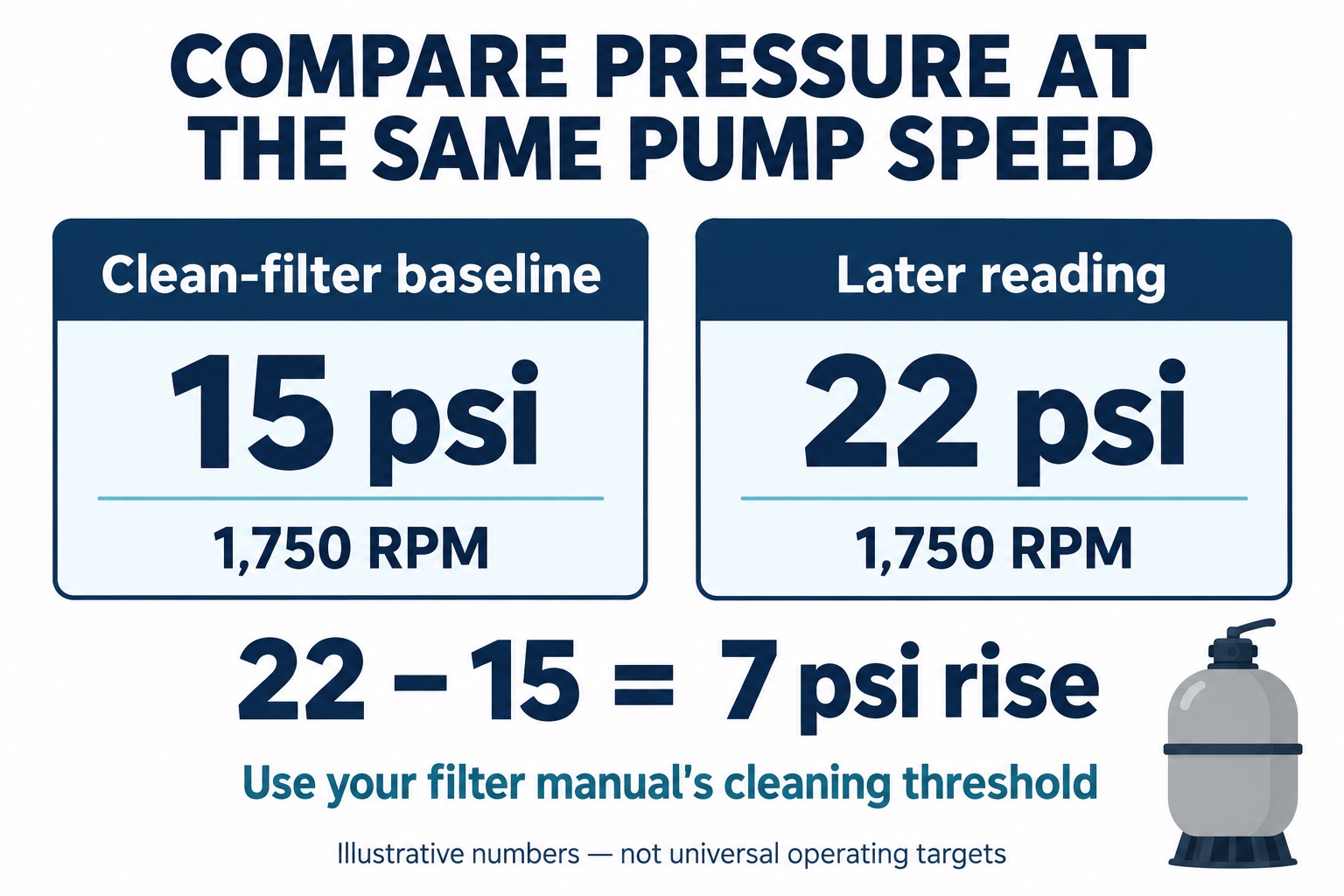
Pressure rise = current pressure − comparable clean-filter pressure. Use the same units and matching operating conditions.
For illustration only, suppose a professional documented 15 psi at 1,750 RPM after servicing. A later reading of 22 psi at that same speed is a rise of 7 psi. Neither 15 nor 22 is a universal target, and these numbers are not readings from a pool we tested.
If the later reading instead comes from 2,750 RPM, write it as a separate condition. Do not label the difference from the 1,750-RPM baseline as “filter dirt buildup.” Ask the professional to establish comparable readings for the normal programmed speeds if you need more than one baseline.
Apply the exact model’s criteria
The Clean & Clear Plus manual calls for cleaning at approximately 10 psi above the original starting pressure or when flow significantly falls. That example is not a universal rule for other cartridge, sand, or D.E. filters. It is also not a declaration that a smaller increase is always safe.
In the illustrative 7-psi example, the pressure rise alone has not reached that manual’s approximate 10-psi cleaning criterion. A significant flow reduction would still matter. Record both observations and contact the professional when the manual calls for service or the system behaves abnormally; do not keep running a problem system to reach a number.
Do not confuse a cleaning trigger with a component’s maximum pressure rating. The former helps schedule service; the latter is an equipment safety limit. Never use a maximum rating as a desired operating pressure.
High, low, or unreliable: describe before diagnosing
Pentair’s pool-opening guidance says abnormal readings should be checked by a pool professional. It notes that low readings can accompany water-supply or pump-leak problems; an abnormal gauge does not automatically mean a dirty filter.
- Higher than a comparable baseline: Send the baseline, current reading, RPM, mode, and flow observations. Do not assume the cartridge is the only possible cause.
- Lower with weak returns: Report the weak flow and any safely visible bubbles or water-level change. Our pool pump not pulling water guide covers the separate suction/priming decision path.
- Unreadable, damaged, or implausible gauge: Do not use it to judge safety. The Clean & Clear Plus manual calls for replacement of damaged, difficult-to-read, or incorrectly reading gauges; leave replacement and verification to the professional.
A service message you can fill in
“My filter is ______ and pump is ______. The recorded clean baseline on ______ was ______ at ______ RPM in ______ mode. Today’s reading is ______ at ______ RPM in ______ mode. Return flow appears ______. The change began after ______. I have not opened or adjusted the filter.”
If service identifies a worn cartridge, use our replacement cartridge identification worksheet to confirm the housing model, correct part, and kit quantity before ordering. Pressure alone does not identify a replacement element.
Research and limitations
TemperatureMaster Editorial used AI-assisted research and writing checked against the linked Pentair sources. The worksheet and arithmetic example are editorial aids, not an on-site pressure test, equipment certification, or professional inspection. Your exact equipment instructions take priority. See our editorial policy.

Pool Pump Not Pulling Water? Causes and Safe Fixes
Sunday 4th of October 2026
[…] interpreting the gauge, compare it with the clean-filter reading at the same pump speed. Our pool filter pressure baseline worksheet shows how to record comparable conditions and apply the exact filter manual’s service […]