
A radiator cover must fit the radiator, valves and room—not merely match the width of the metal panel. Record the equipment envelope first, then use the chosen cover maker’s measuring convention. Internal clearance, external cabinet size, ventilation and access are different requirements.
This guide concerns decorative covers for suitable hot-water radiators. Do not apply it to electric heaters, baseboard units, steam equipment, or another appliance without its manufacturer’s explicit approval. For budgeting rather than measurement, see our radiator-cover cost guide.
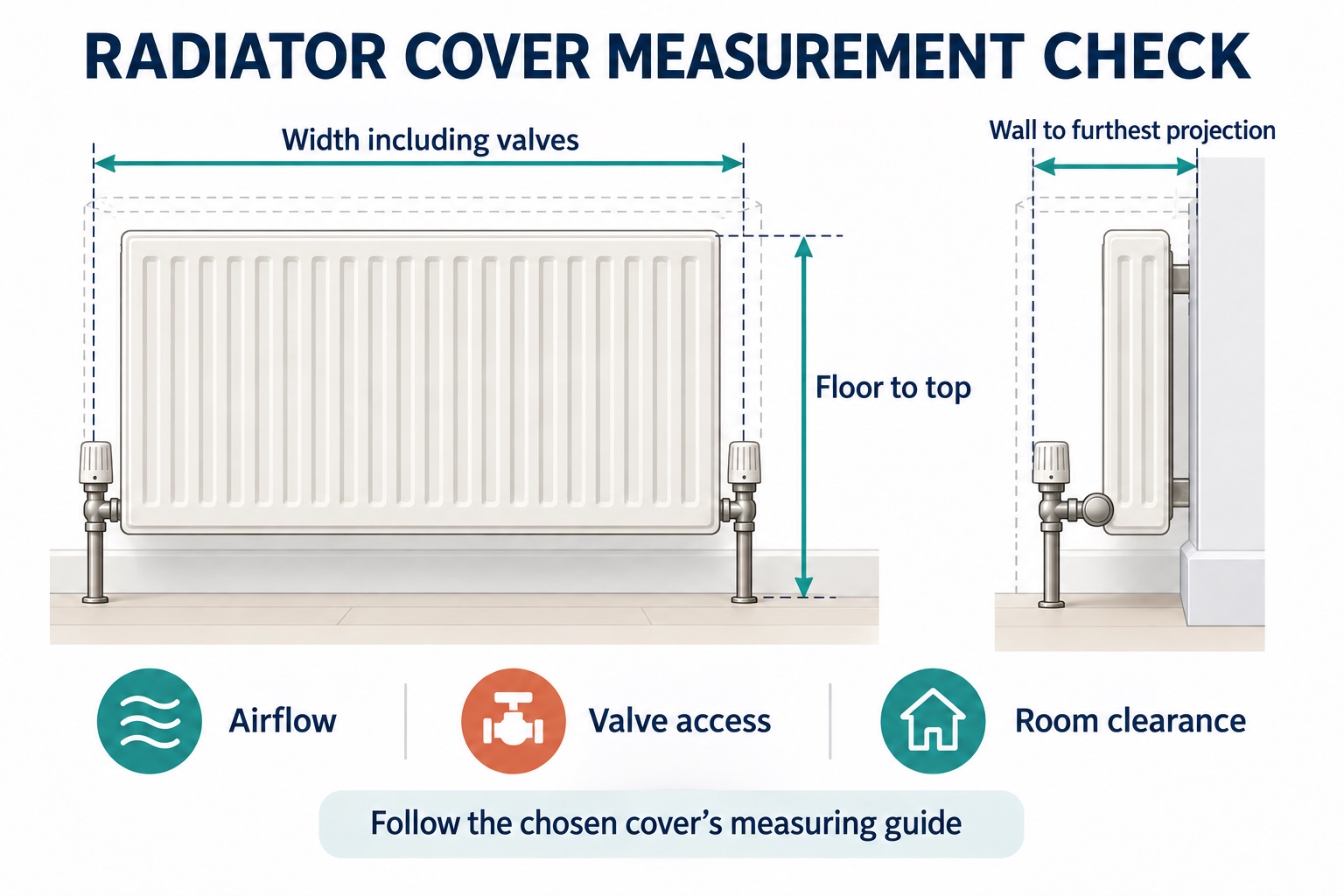
Measure the equipment envelope, not the proposed cabinet
Let the radiator cool before measuring. From a stable floor position, record the furthest projections—including valves, fittings and any projecting sensor. Keep one unit of measurement throughout and label your sketch. Do not loosen pipework or change valves to obtain a neater measurement.
Radiator Cabinets UK’s measuring guide uses valve-to-valve width, floor-to-top height for standing covers, and depth from the wall. It specifies a different height reference for floating designs, and its calculator adds the maker’s allowances to the entered radiator measurements.
That last distinction matters: if a supplier asks for raw radiator dimensions and adds allowances, adding your own clearance first can produce an oversized cabinet. If another seller asks for finished internal dimensions, the process differs. Ask which convention applies before submitting a number.
Keep raw, internal and external dimensions separate
| Dimension group | Meaning | Question for the maker |
|---|---|---|
| Raw equipment envelope | Radiator and projecting parts measured at the specified reference points | Do your inputs include valves and floor height? |
| Finished internal space | Space available inside the cabinet around the equipment | Which clearances does this design require? |
| Finished external cabinet | Overall footprint, including top overhang and panels | Will it clear the sill, door and surrounding furniture? |
Use the maker’s dimensioned drawing rather than subtracting panel thickness from a product photograph. “Fits a 1,000 mm radiator” is ambiguous if the listing does not explain whether that includes the valves. Request clarification instead of interpreting a marketing size as an engineering drawing.
A hypothetical order check
Imagine a panel that measures 1,000 mm wide but whose valves extend the equipment envelope to 1,140 mm. If the supplier asks for width including valves, entering 1,000 mm loses 140 mm of required equipment space before any cabinet allowance is considered.
The numbers are invented to show the distinction. They do not prescribe clearance. Your order should state both what you measured and what the supplier will add, with the final internal and external dimensions confirmed separately.
Airflow and thermostat sensing need separate checks
Radiator Cabinets UK’s FAQ describes upper and lower ventilation gaps in its designs. That is a manufacturer’s design claim, not evidence that every decorative enclosure has no effect on heat output. Do not block grilles or use a generic numerical air gap as approval for an unverified design.
A thermostatic radiator valve also needs to sense the room appropriately. Danfoss’s user guidance warns against hiding its sensor behind furniture or thick curtains and discusses a remote sensor where needed. Ask a qualified heating professional whether the proposed cover would affect your valve’s sensing and what approved arrangement is suitable. This is not an instruction to relocate or replace it yourself.
Check access and the surrounding room
Use a removable-cover or access-panel plan that the maker supplies. Ask how the radiator, valves and any permitted maintenance points can be reached after installation, and whether the cabinet can be removed without disturbing pipework. A grille that looks open is not necessarily a usable service opening.
- Measure the window sill and any overhang above the radiator.
- Record skirting-board height and depth at the cabinet location.
- Check door swing, nearby sockets and adjacent furniture.
- Confirm how a standing, wall-mounted or clip-on design is secured.
- Ask which wall type and fittings the maker approves; seek professional advice where construction or hidden services are uncertain.
Do not drill into a wall without establishing a safe fixing method and checking for concealed services. Do not assume a cover is suitable for sitting, climbing or heavy display objects. Follow its stated load and securing instructions.
Send the supplier a clear approval request
Keep a front and side sketch showing measurement endpoints, the raw width/height/depth, projections, surrounding obstructions, and the exact radiator and proposed cover type. Ask the supplier to confirm:
- The input convention and any automatically added allowances.
- Finished internal and external dimensions.
- Approved radiator type and ventilation requirements.
- Valve/sensor and service access.
- Securing instructions and removal method.
Resolve unexplained requirements before ordering. If the heating system type is uncertain, seek qualified identification first. For broader hazards, our radiator safety guide addresses risks beyond cabinet fit; a decorative cover is not a universal burn or fire safeguard.
Research and illustration limits
TemperatureMaster Editorial prepared this guide with AI-assisted research and writing checked against the linked cover-maker and Danfoss publications. The ordering example is hypothetical. We have not measured a customer’s radiator or tested a cabinet’s heat output. The illustration shows measurement concepts, not construction clearances. See our editorial policy.
