
A window air conditioner must pass two different checks: enough cooling capacity for the room and an approved fit in the window. Begin with floor area and room conditions, then compare the candidate model’s window, support, and electrical requirements. Buying the largest BTU rating you can afford is not a sizing method.
This guide helps you prepare a purchase worksheet. It does not replace installation instructions or a professional cooling-load assessment. If an existing unit is malfunctioning, use our GE window AC troubleshooting guide rather than assuming the room needs a larger appliance.
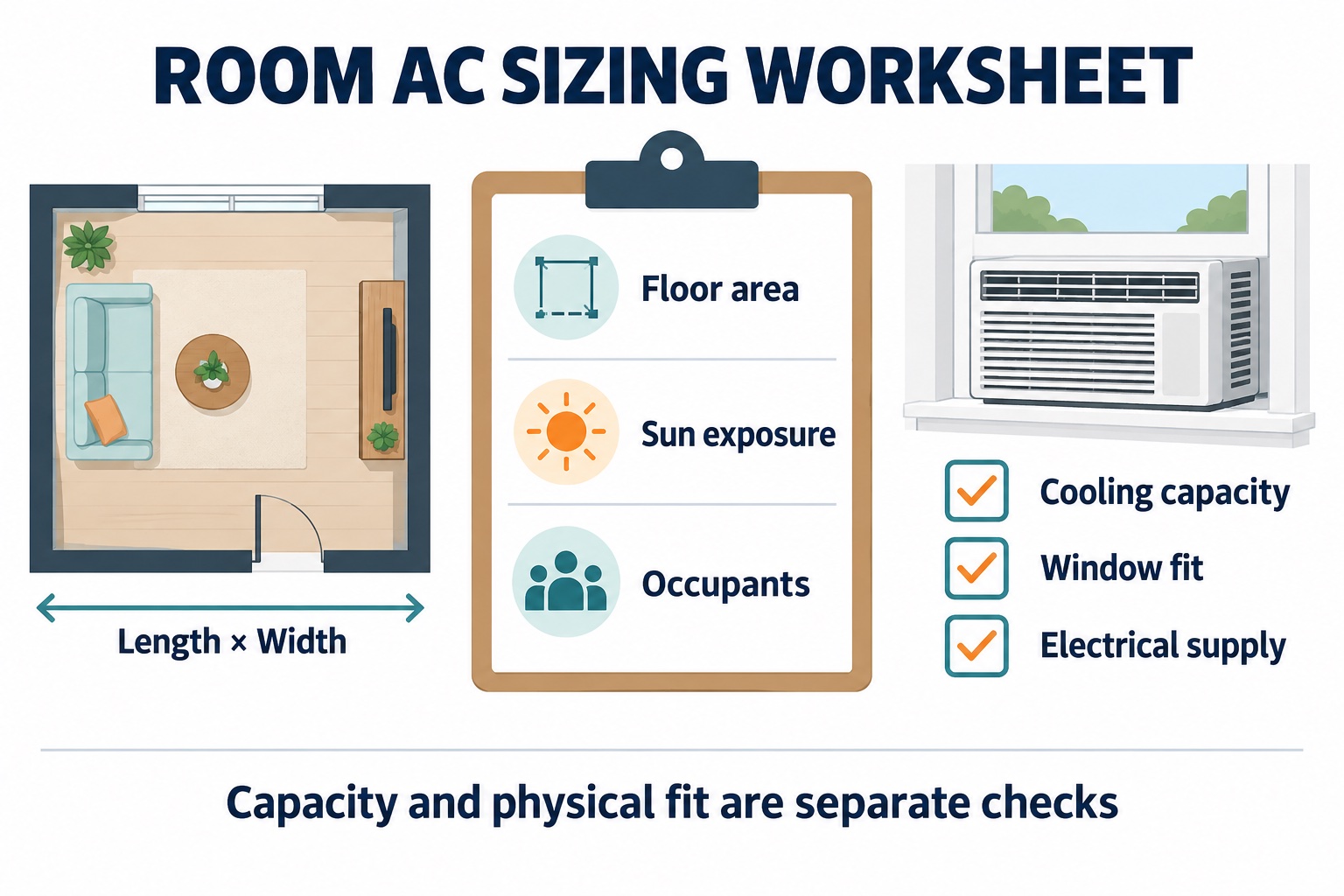
Start with the room you actually intend to cool
Measure floor length and width in feet, using decimal feet for inches: 12 feet 6 inches becomes 12.5 feet. For a rectangle, multiply length by width. For an irregular room, sketch separate non-overlapping rectangles and triangles, calculate each area, and add them.
Do not quietly count a closed bedroom as part of an adjoining living room, or assume air will turn corners through a hallway. Write down the intended cooling zone and door arrangement. If you want one appliance to cool several spaces, take the sketch to the supplier or an HVAC professional rather than relying on total floor area alone.
Use the published capacity chart as a starting point
ENERGY STAR’s room-AC guidance bases its chart on an eight-foot ceiling. Selected examples are 6,000 BTU/hour for 150–250 square feet, 8,000 for 300–350, and 12,000 for 450–550. Consult its complete chart for other sizes.
The same guidance adjusts capacity by minus 10% for heavy shade or plus 10% for a very sunny room; adds 600 BTU/hour per regular occupant beyond two; and adds 4,000 BTU/hour for kitchen use. These are preliminary chart adjustments, not a detailed assessment of insulation, unusual glazing, ceilings, or local conditions.
Worked example: keep the assumptions visible
Our hypothetical room measures 12 by 16 feet: 12 × 16 = 192 square feet. It has an eight-foot ceiling, is not a kitchen, has two regular occupants, and is very sunny. The chart starting point is 6,000 BTU/hour. Applying the sun adjustment gives 6,000 × 1.10 = 6,600 BTU/hour.
That result is an estimate to discuss with the seller, not an instruction to buy a nonexistent “6,600 BTU” model or automatically jump to the next largest size. Record which assumption produced the adjustment. If your room’s ceiling or heat load differs substantially, ask for a more suitable assessment.
Why bigger can feel worse
ENERGY STAR explains that an oversized unit can cool a space before removing enough humidity, leaving it damp and uncomfortable. Capacity is also not the same as airflow direction. A well-sized appliance still needs an unobstructed path to the intended space.
Before replacing a unit, distinguish “the whole room stays warm” from “one distant corner stays warm” and “the room is cool but clammy.” Those descriptions ask different questions. They do not diagnose a failed compressor or establish that more capacity is the answer.
Window fit: cabinet width is not minimum opening width
GE’s explanation of width dimensions distinguishes unit width from the opening needed with its side curtains installed. Do not compare your window only with the bare cabinet measurement.
Use the model-specific installation requirements to confirm window type, opening width and height, sill details, support method, and surrounding clearances. A suitable BTU rating does not authorize improvised brackets or a different window type. Do not lean outside or attempt to hold a heavy unit while measuring.
Prepare a two-stage purchase sheet
| Capacity screening | Model-specific fit screening |
|---|---|
| Room sketch and total floor area | Full candidate model number and manual revision |
| Ceiling height and connected spaces | Approved window type and opening range |
| Sun exposure and regular occupants | Sill/support and clearance requirements |
| Kitchen or unusual heat sources | Required supply, outlet and circuit |
| Chart estimate and unresolved assumptions | Safe lifting/installation arrangements |
Keep measurements and model requirements in separate columns. “My opening is ___” is a site observation; “the manual permits ___” is a product requirement. A blank requirement should not become a guessed measurement. If the two columns conflict, change the candidate or seek qualified advice.
Electrical and installation limits
GE’s power-cord guidance prohibits extension cords, surge protectors, and multi-outlet adapters for its room ACs. Confirm your model’s supply requirements with a qualified electrician if necessary; never alter a plug or defeat its grounding.
Follow the exact installation manual, including support, drainage orientation, weather sealing, and lifting assistance. This worksheet deliberately does not prescribe a universal tilt or bracket arrangement. For operating-control questions after a correct installation, see our Friedrich troubleshooting guide.
How the worksheet was prepared
TemperatureMaster Editorial used AI-assisted research and writing checked against ENERGY STAR and GE documentation. The room example is invented to explain the calculation, not a measured house or product test. This is a selection aid, not a guaranteed cooling-load calculation. See our editorial policy.
