
Choose a furnace filter by its fit and your system’s requirements before choosing a filtration rating. Record the nominal label, actual frame dimensions, filter cabinet identity, and approved replacement specification. A higher MERV number cannot compensate for the wrong size or an unsuitable filter.
This is a purchasing and owner-record guide for central forced-air heating and cooling. It is not a filter-cabinet modification or furnace repair tutorial. If you are investigating unusual discoloration rather than selecting a replacement, start with our guide to black furnace filters.
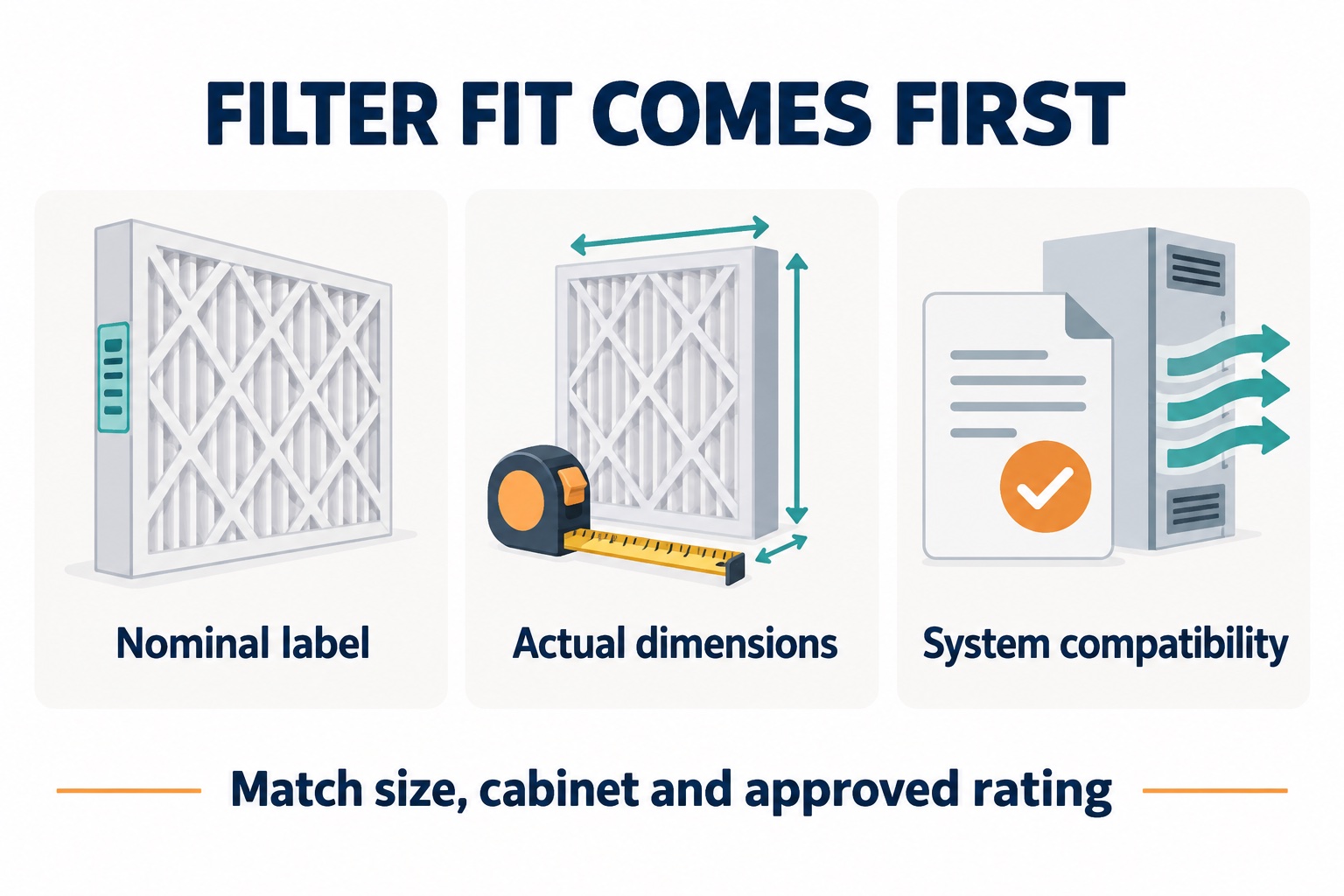
Separate the three decisions on the shopping label
| Decision | What to record | What it does not establish |
|---|---|---|
| Nominal size | The size name printed on the frame or package | The exact physical dimensions of every brand |
| Actual size and cabinet fit | Frame length, width, thickness; cabinet model and approved part | The system’s ability to accommodate a filtration upgrade |
| Filtration performance | MERV and the specific product specification | Pressure drop or a universal replacement interval |
Keep a photograph of the old label, but do not treat an unknown previous installation as proof of compatibility. If the frame was crushed, loose, or improvised, use the equipment documentation or a qualified HVAC professional to establish the correct replacement.
Nominal versus actual dimensions: why the same label can mislead
In its refillable-filter FAQs, Filtrete explicitly cautions that nominal size can be described differently by brand or system and tells customers to check the actual frame size. That is a reason to compare specifications, not to apply a universal “subtract half an inch” rule.
Use the owner manual’s shutdown and filter-access procedure. Only measure a removable filter that you can reach safely; do not remove service panels or reach near moving components. Record all three dimensions in the same unit. Match the replacement’s published actual dimensions and cabinet compatibility, including its thickness—not just the two large face dimensions.
Filtrete’s filter-selection guidance also emphasizes the system’s required size and thickness. A small filter can leave a bypass gap. Do not bend, stack, trim, or force a replacement into place, and do not remove the cabinet’s guides to accommodate a different product.
What MERV tells you—and the missing airflow question
MERV means Minimum Efficiency Reporting Value. It describes particle-capture performance under a standardized test; proprietary MPR and FPR labels are not the same numbering scale. The EPA’s explanation of MERV recommends MERV 13, or the highest rating the fan and filter slot can accommodate.
The qualification matters. The EPA’s filtration technical bulletin explains that filter resistance, duct design, and filter-box dimensions affect airflow. MERV alone is not a pressure-drop specification. Ask an HVAC professional to assess the proposed filter at the system’s operating airflow when an upgrade’s suitability is uncertain.
Do not conclude that every one-inch MERV 13 filter is unsuitable, or that every deeper filter is automatically acceptable. Compare the exact product and cabinet requirements. A professional may need information that a retail listing does not provide.
A comparison worksheet you can take to the supplier
This is an editorial worksheet, not a manufacturer-approved product comparison. Fill both candidate columns before ordering; an unanswered compatibility field is a reason to ask, not guess.
| Field | Current approved replacement | Candidate filter |
|---|---|---|
| Brand and complete part number | ________ | ________ |
| Nominal size | ________ | ________ |
| Actual length × width × thickness | ________ | ________ |
| Compatible cabinet/model | ________ | ________ |
| MERV and supporting specification | ________ | ________ |
| Airflow/pressure suitability confirmed by | ________ | ________ |
| Care instructions and inspection interval | ________ | ________ |
For example, two packages might display the same nominal size while listing different actual depths. Neither the matching label nor the higher advertised rating settles the purchase. Ask the cabinet manufacturer which part fits, then ask about the proposed rating. This hypothetical example explains the decision order; it does not endorse a filter.
After replacement: keep a useful record
Follow the equipment manual’s installation and airflow-arrow instructions. Record the replacement date and part number, then inspect on the schedule specified for the filter and equipment. The EPA’s homeowner guide warns against leakage around an ill-fitting frame. Appearance alone does not establish performance or remaining life.
If heating or cooling changes after a replacement, report the old and new product specifications and when the change began. Do not solve an airflow concern by running without a filter. For Goodman equipment, our model-number and manual worksheet helps identify the correct document before looking for filter instructions.
Stop using equipment with smoke, burning smells, repeated electrical trips, or other shutdown warnings. For a carbon-monoxide alarm or gas odor, get outside and contact emergency services or the gas utility; filter shopping is not the next step.
Research and limits
TemperatureMaster Editorial prepared this guide with AI-assisted research and writing checked against the linked EPA and manufacturer publications. The comparison worksheet and example are editorial tools, not hands-on filter tests or a licensed HVAC review. See our editorial policy.
