
Radiators can use electricity directly, or receive hot water or steam from equipment elsewhere. A pipe-connected radiator is not automatically “gas”: its appearance does not identify the fuel used by the building’s heating plant. Conversely, an oil-filled portable radiator usually uses an electric element, not a flame burning the oil.
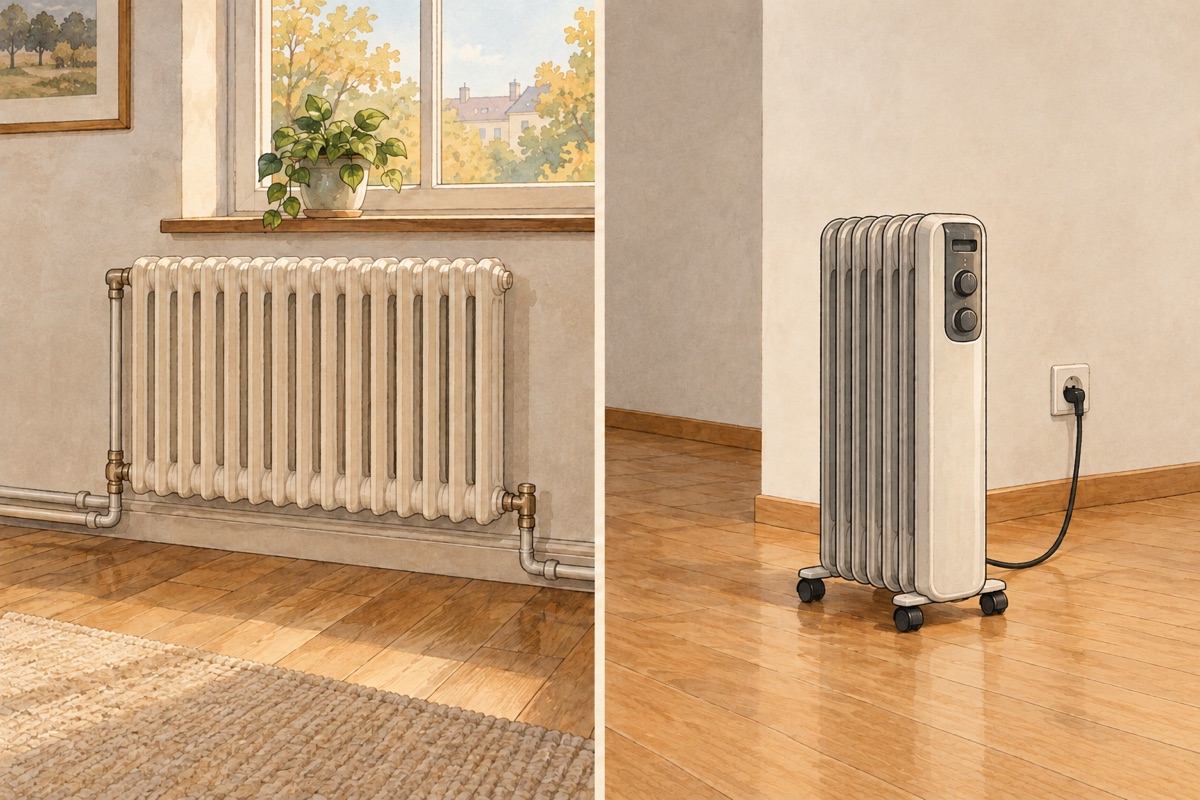
Separate two questions: What is installed in this room? And what produces the heat it receives? Answering both avoids choosing the wrong replacement valve, cover or repair instructions.
The room unit and the heat source are different things
The US Department of Energy’s heating overview distinguishes boilers, which distribute heated water or steam through pipes, from electric resistance heating. It lists multiple boiler fuels. A building may also have a shared plant rather than equipment inside your apartment.
| What you can observe without opening anything | What it suggests | What still needs confirmation |
|---|---|---|
| Pipes connect the room unit to the building | A fluid-connected emitter | Hot water versus steam, system layout and actual heat source |
| A heater label gives electrical voltage and input power | An electrically powered appliance | Exact model and whether any additional heating connection exists |
| A portable radiator has a cord and its own controls | A self-contained electric heater | Permitted installation, clearances and power supply in its manual |
| No connection is visible | Nothing conclusive | Pipes or wiring may be concealed; request the product or building record |
Use records before touching valves
- Photograph the accessible product label and the whole room unit when safe. Do not lift a heavy heater or reach behind a hot surface to find a sticker.
- Look for a matching manual, property handover document or service record.
- Ask the landlord, building manager or heating contractor to identify the system and its controls. In a shared building, include the apartment and room location.
- Keep the answer in two fields: “room emitter” and “heat source.” Record “unconfirmed” where evidence is missing.
Pipe count, age, a vent-like fitting or a familiar knob can be clues, but no single photograph establishes every system. Do not open a vent or bleed a radiator to find out what comes out. Steam and hot-water components require their own procedures and can release scalding fluid.
Why “oil-filled” does not mean oil-fired
An oil-filled electric radiator uses the internal fluid to transfer heat from an electric element to its body. The oil is not a household fuel supply to top up. Dimplex’s OFXE product description is one plug-in example; it is not an identification guide for every heater that looks similar.
For a sealed oil-filled model, do not remove a cap, drain it or add oil. Dimplex’s DAR support guidance describes its sealed construction. A leak, damaged cord or overheating needs the maker’s service advice, not an improvised refill.
Do radiators work during a power cut?
A directly electric radiator needs its electricity supply. For a pipe-connected system, knowing that the boiler burns gas or oil is not enough to promise continued heating: controls, pumps or other parts may need power. Ask for the outage behavior of the installed system. Residual warmth in metal does not prove the system is still producing heat.
Do not bypass controls or connect a heating system to an improvised backup supply. For rented or shared properties, a building-manager answer is more reliable than experimenting with the controls in one room.
Use the identification to choose the next task
For a cover, confirm that the maker permits one on that exact heater and preserves required airflow, sensor operation and access. A cabinet intended for a fixed central-heating radiator is not permission to enclose a portable electric heater. Our radiator-cover measuring guide addresses dimensions only after those compatibility questions are settled.
For uneven comfort, record the room temperature, control setting and timing without touching hot surfaces. Our air leaks versus insulation guide covers a different possible source of discomfort. Do not replace heating hardware simply because the room is chilly before the system and building conditions are understood.
Editorial method and limits
TemperatureMaster Editorial prepared this research-based guide with AI-assisted research and writing checked against the primary publications linked in the text. Examples and planning aids are editorial constructions, not results from hands-on testing or a professional inspection. The illustration is AI-generated. See our editorial policy.
