
Pool volume is the space actually occupied by water, not the pool’s advertised outer size. For a simple rectangular water body, multiply internal water length by width by average water depth. Convert the result to the units required by the equipment manual or product label.
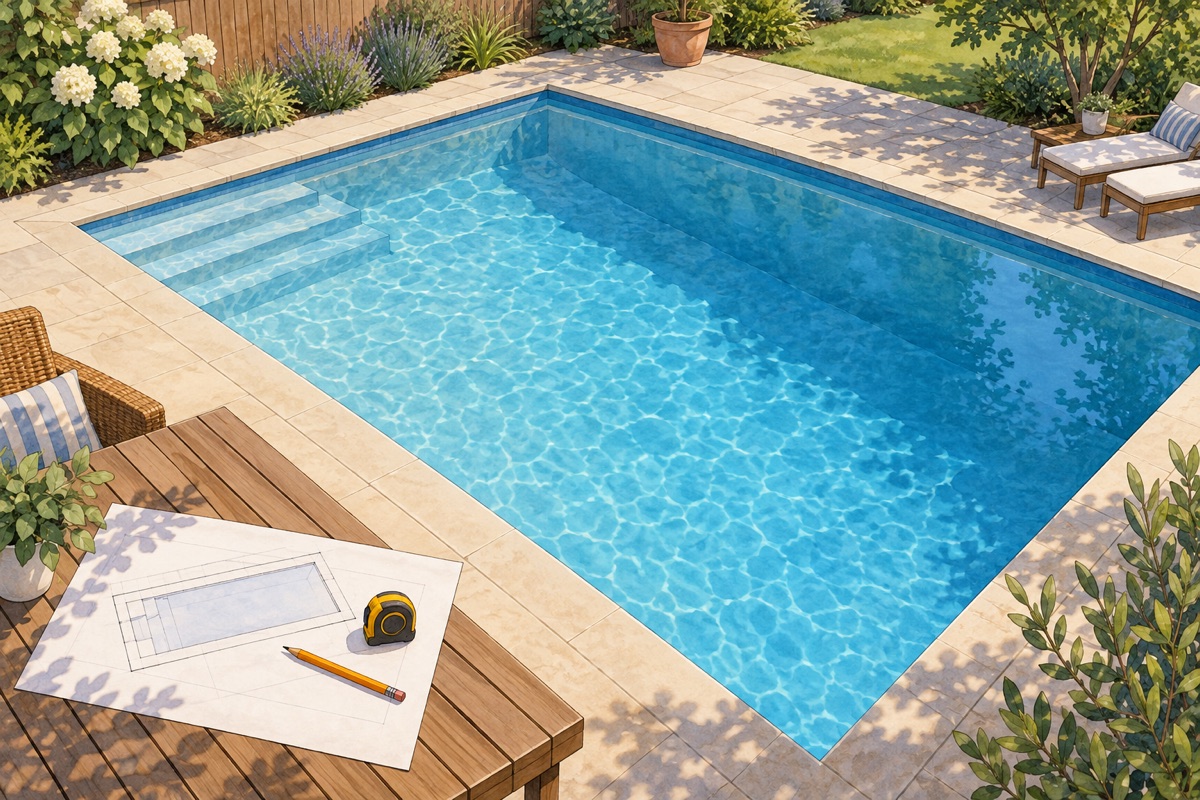
The difficult part is usually not the multiplication. It is deciding whether “average depth” really describes the floor, whether a ledge has been counted twice, and whether a label means US gallons, Imperial gallons or litres. Those mistakes carry into water-treatment calculations.
Find the best starting number
Check the builder’s as-built documentation or the exact pool model’s operating-water capacity first. Confirm the dimensions, floor configuration and water level associated with that number. An old quotation or the volume of a similar model is weaker evidence than a record matching the installed pool.
If you estimate, use measurements available safely from plans or suitable equipment. Do not lean over a deep pool, enter water to take measurements alone, drain it for measurement, or place electrical measuring tools near water. A pool professional can help where the shape or access makes an owner estimate unreliable.
The simple rectangular calculation
Cubic feet = length in feet × width in feet × average water depth in feet. Then multiply by approximately 7.48 for US gallons. If all three measurements are metres, the result is cubic metres; multiply by 1,000 for litres.
Pentair’s Sta-Rite engineering manual gives the area-times-depth approach and the 7.48 US-gallon conversion. Its geometric examples are estimates, not a survey of your pool. Do not combine a length in feet with a depth in inches.
For an invented rectangular example with a flat floor: 24 ft × 12 ft × 4 ft = 1,152 cubic feet. That is about 8,617 US gallons. An actual shallow ledge occupying part of that rectangle would reduce the water volume; the bare multiplication assumes the whole footprint is four feet deep.
When the shallow/deep average works—and when it does not
If the entire rectangular floor slopes evenly from three feet of water at one end to six feet at the other, the average is (3 + 6) ÷ 2 = 4.5 feet. But a pool with a long flat shallow floor, a short transition and a deep well does not give equal weight to those endpoint depths.
Split such a pool into non-overlapping sections. For a hypothetical 30-by-12-foot pool with vertical walls and no steps:
| Section | Calculation in feet | Cubic feet |
|---|---|---|
| 12-foot flat shallow section | 12 × 12 × 3 | 432 |
| 6-foot evenly sloped transition, 3 to 6 feet deep | 6 × 12 × 4.5 | 324 |
| 12-foot flat deep section | 12 × 12 × 6 | 864 |
| Total | 432 + 324 + 864 | 1,620 |
The sectional total is about 12,118 US gallons. In this deliberately balanced example the endpoint shortcut happens to give the same answer. Change the shallow section to 18 feet and the deep section to six feet, keeping the transition six feet long: the total becomes 1,404 cubic feet, or about 10,502 US gallons. The unchanged endpoint shortcut would still report 12,118—a meaningful error caused by geometry, not rounding.
Account for steps without counting the same space twice
Either model each section using its actual water depth, or calculate a simple envelope and subtract the solid space occupying it. Do not do both for the same ledge. A submerged shelf is not empty water extending to the deep floor.
For curved, tapered or freeform pools, a bounding rectangle overstates the footprint. Divide the plan into appropriate shapes or obtain a verified capacity. Use a circle’s radius, not its diameter, in π × radius² × depth. Do not apply a generic “kidney shape percentage” to a pool whose dimensions you have not established.
Carry uncertainty into treatment planning
Record the water level, method, units, section assumptions and rounded result together. For example, “estimated 10,500 US gallons at normal operating level; step allowance not verified” is more useful than an unexplained “10,502.” Extra decimal places do not make rough measurements exact.
Use the estimate with the exact product label and a qualified professional where appropriate. It is not an automatic dose, draining plan or pump-running schedule. For related applications, see calcium hardness and dilution and saltwater testing and generator care. Confirm a disputed capacity before using it to justify a substantial chemical addition.
Editorial method and limits
TemperatureMaster Editorial prepared this research-based guide with AI-assisted research and writing checked against the primary publications linked in the text. Examples and planning aids are editorial constructions, not results from hands-on testing or a professional inspection. The illustration is AI-generated. See our editorial policy.
