
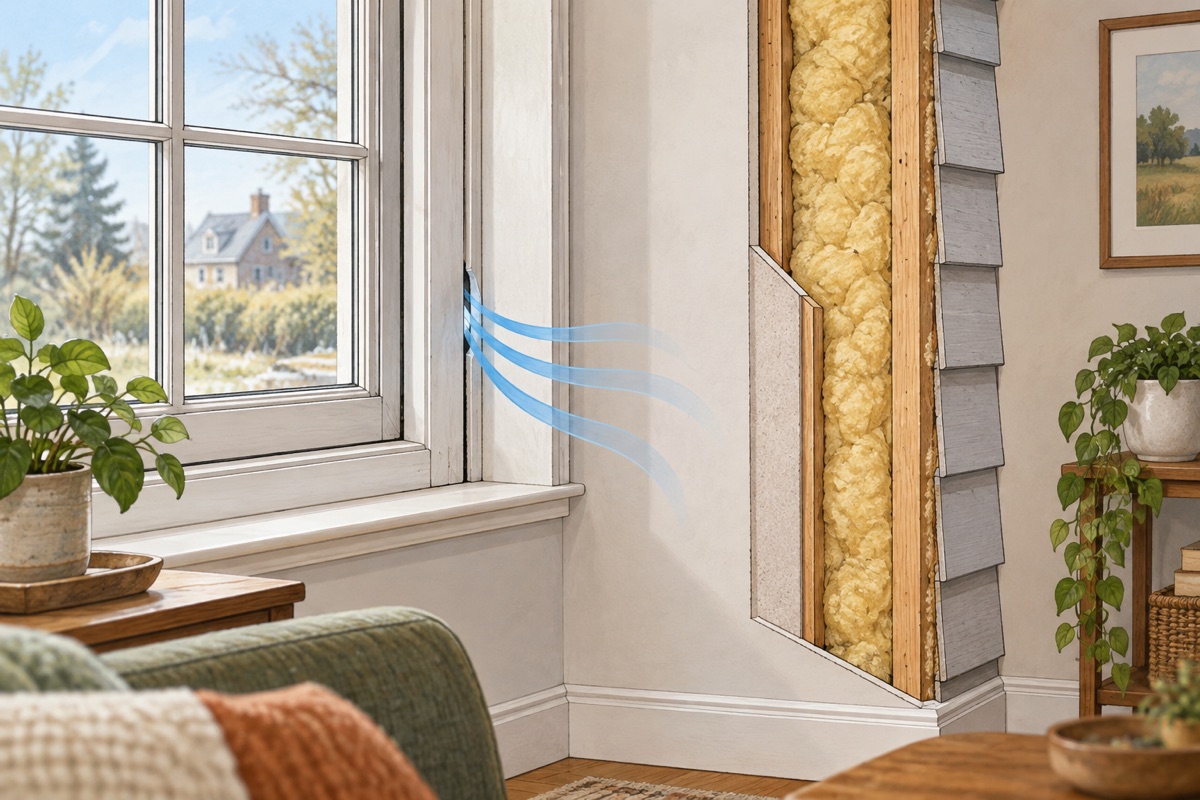
Air leakage and insufficient insulation can both make a home uncomfortable, but they are not the same problem. Air leakage involves air passing through gaps; insulation limits heat transfer through building assemblies. A house can have either issue, both, or another cause of discomfort entirely.
Do not buy the diagnosis from one symptom
A cold-feeling wall, a hot upstairs bedroom or a draft at a window is a clue, not a complete building assessment. Sunshine, wind, moisture, cooling capacity and how rooms connect can change the pattern. Record the pattern before assuming a new AC unit or more insulation is the answer.
The US Department of Energy’s air-sealing guide explains the distinction between insulation and air barriers. Improving one does not automatically correct the other, and safe ventilation still needs to be preserved.
Start with a room-by-room observation sheet
| Record | Useful question | Limit |
|---|---|---|
| Room, time and outdoor weather | Does discomfort change with wind or time of day? | Weather correlation is not a measured leak rate. |
| Sun exposure and shading | Does one window receive strong afternoon sun? | A hot room does not prove missing wall insulation. |
| Window/door condition | Are visible gaps or damaged seals present? | A visible defect does not quantify whole-home leakage. |
| Heating/cooling settings and airflow | Was the equipment operating, and were vents unobstructed? | Low comfort can involve equipment or distribution, not just the envelope. |
| Moisture or material damage | Is professional investigation needed before covering or sealing? | Do not conceal dampness or disturb unknown materials. |
Keep observations simple and repeatable. Note what you can see and feel from a safe position; do not probe wall cavities, remove socket covers or disturb suspected asbestos-containing materials. Do not use a flame or smoke source to search for leaks.
Compare patterns without claiming certainty
Imagine a room that feels drafty only on windy evenings near a visibly damaged window seal. That suggests an air-path question worth investigating. Now imagine a room that becomes hot behind an unshaded west-facing window on sunny afternoons. That suggests solar gain should be considered. Neither invented example proves an insulation defect.
If multiple rooms remain uncomfortable with a consistent indoor/outdoor temperature difference, the explanation may involve several assemblies or the mechanical system. A hand on the wall cannot establish an insulation R-value, and a phone’s ordinary camera is not a thermal survey.
Know what a professional assessment adds
DOE’s home-energy-assessment guide describes a more systematic review. Depending on the home and scope, an assessor may use blower-door testing, infrared equipment or other checks. Ask which measurements will be provided and how the recommendations address the actual complaint.
Do not reproduce a depressurization test yourself. Combustion appliances, flues, exhaust systems and ventilation require safety consideration. The fact that a gap is visible does not mean every opening should be sealed.
Turn findings into a prioritized work request
Give the contractor your room log, accessible photographs and a description of moisture or damaged materials. Ask them to distinguish confirmed defects from assumptions, explain the proposed sequence, and address ventilation and moisture before concealing the work.
A useful proposal states the affected location, intended improvement, access method, materials, safety checks and how the result will be verified. A promise to “save 30%” without a home-specific basis is less useful than a clear explanation of the problem and evidence.
Manage comfort while the cause is investigated
Use safe shading and suitable cooling, and ventilate for cooling only when outdoor conditions help. Fans provide air movement rather than a guaranteed room-temperature drop. Our practical cooling guide for poorly insulated homes separates these short-term measures from building repairs.
If conditions become unsafe during extreme heat or cold, move to an appropriate safe location and follow local guidance. An observation worksheet is not a reason to delay urgent help or to keep operating damaged heating/cooling equipment.
How this guide was prepared
TemperatureMaster Editorial prepared this guide with AI-assisted research and writing checked against the linked manufacturer or government publications. The worksheet and examples are editorial tools, not measurements from a customer installation. We have not tested the equipment or inspected a home for this guide. See our editorial policy.
