
Measure a solar pool blanket against the waterline shape, then confirm the product’s trimming and handling instructions before cutting. Pool dimensions, projecting steps, ladders and reel arrangements can change the usable fit. A floating bubble blanket is not an anchored safety cover.
Remove the entire blanket before anyone enters the pool. Never swim beneath it or leave a section floating while people swim. The CPSC’s solar-cover warning describes the entrapment and drowning risk of partially covered pools. Do not treat a solar blanket as a substitute for barriers or active supervision.
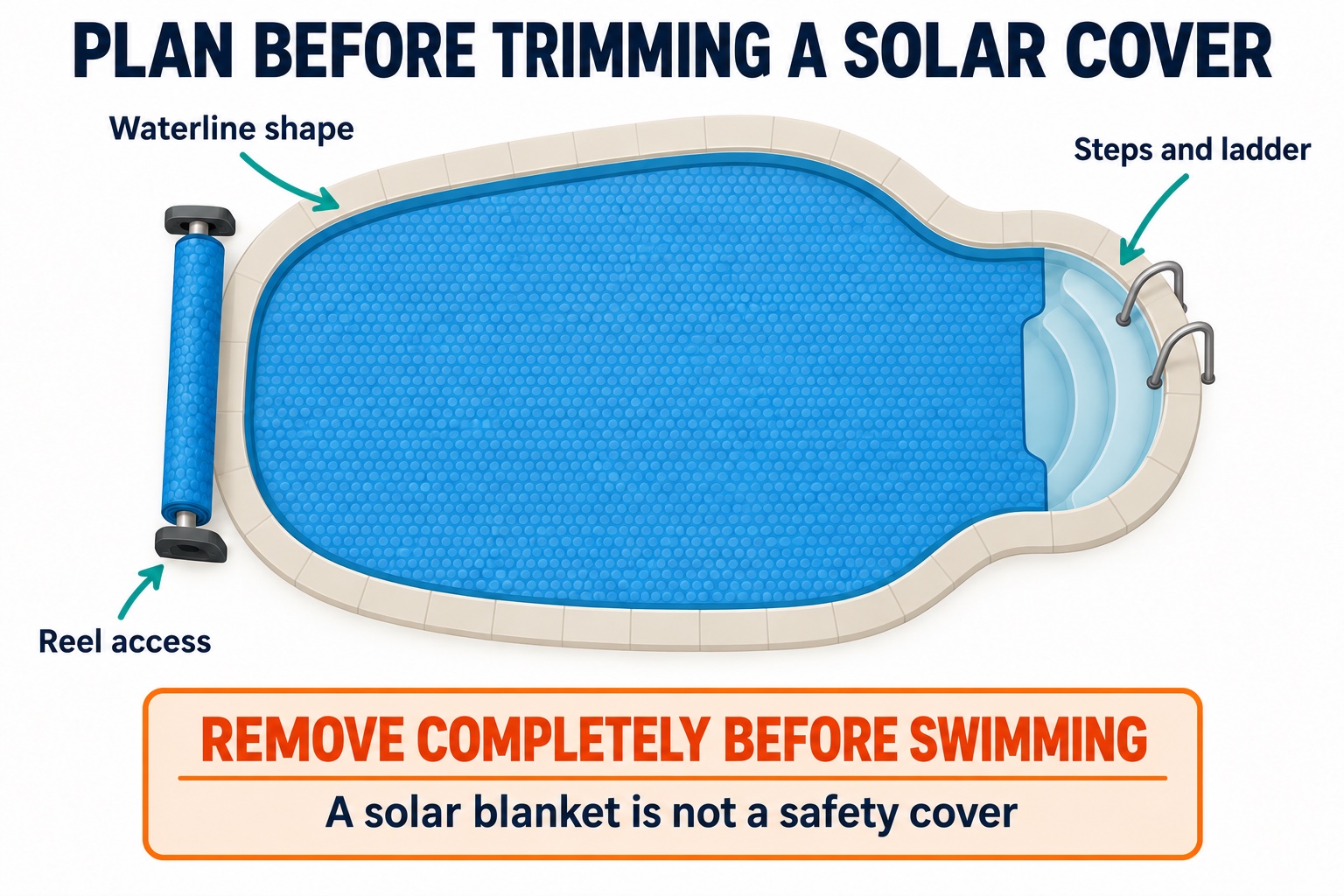
What to measure before choosing a size
From a safe position, sketch the waterline—not just the outside deck. Mark the main span, any step alcove, curves, ladder location, and intended handling area. Keep children and pets away during fitting. Do not lean over water, balance on coping, or enter the pool to obtain a measurement beneath a blanket.
Ask the seller whether the quoted dimensions describe the untrimmed sheet and whether the product is intended to be cut. A nominal “pool size” on a package is not a complete fit plan for an irregular pool. For product-selection criteria, see our solar-cover research guide; this article addresses measuring and handling rather than ranking products.
Hypothetical fit example
Suppose the main waterline is 16 by 32 feet, but a step alcove extends beyond that rectangle. A 16-by-32-foot sheet might cover the main section without covering the alcove. Before buying, show the drawing to the supplier and ask which untrimmed shape covers the intended area and how that cover can be removed safely.
Those dimensions are an invented purchasing example. They are not a cutting template. An oversized rectangle is not automatically compatible with every reel or irregular outline.
Use the chosen product’s trimming rule
In The Swim’s instructions for its solar covers describe bubble-side-down placement, trimming an oversized blanket, and leaving a gap around edges, steps or ladders to ease removal. Treat that advice as supplier-specific, not a universal clearance for every blanket.
Before cutting, read the supplied instructions and clarify any conflicts with the listing or general advice. Ask whether the sheet needs to settle first, how the edge should fit, what to do around obstacles, and whether the planned trim affects returns or warranty coverage. Do not assume a seller accepts a cut sheet back.
Plan cutting on a stable, dry work surface away from swimmers, pool liners and other damage-sensitive surfaces. If the material is too large to handle securely, get suitable assistance or professional fitting. Do not cut while leaning over the pool or while someone is underneath the sheet.
Plan removal and storage before committing to the outline
A cover that fits the water but cannot be removed completely is not a usable solution. Confirm the reel’s capacity, attachment method, compatibility with the blanket, and safe operating position. Leave enough clear space to handle and store the whole cover without creating a trip hazard or blocking access.
Before the first swim, demonstrate removal with the pool empty of people and the perimeter controlled. Check that no fragment or folded section remains on the water. If a torn section cannot be accounted for, resolve that before anyone enters. Do not improvise weights, anchors, or safety-cover straps on a floating blanket.
A pre-cut decision record
| Question | Answer to keep with the order |
|---|---|
| What is the measured waterline outline? | Sketch, units, main spans and projecting steps |
| What sheet will arrive? | Exact product, untrimmed dimensions and shape |
| Is trimming permitted? | Instruction reference and supplier confirmation |
| What happens around obstacles? | Product-specific treatment of steps and ladders |
| How is it removed completely? | Compatible reel or documented handling plan |
| Where will it be stored? | Clear location and required protective covering |
| What changes after cutting? | Return/warranty terms checked before the cut |
This editorial record is meant to expose missing information before an irreversible cut. It is not a substitute for the cover’s instructions or an installation approval.
Care and water-saving claims: keep the limits visible
The EPA’s pool-efficiency guidance identifies properly used covers as a way to reduce evaporation and retain heat. It discusses multiple cover types; that does not mean a bubble blanket provides safety protection. Your savings depend on the pool and actual cover use, so we do not promise a particular temperature increase.
In The Swim also advises protection from sun when stored off the water and removal during super-chlorination. Use your exact product’s chemistry, storage and temperature limits. Our bubble-orientation guide covers that separate setup question. For seasonal closure, use our above-ground winterization guide rather than treating a summer blanket as a winter-cover system.
Research method
TemperatureMaster Editorial used AI-assisted research and writing checked against the linked CPSC, EPA and supplier publications. The example and worksheet are editorial tools; we have not fitted or tested a blanket on a physical pool. The illustration is conceptual, not a cutting plan. See our editorial policy.
