
To identify a replacement pool filter cartridge, match the filter housing model, the manufacturer’s replacement part, the cartridge’s dimensions and end configuration, and the number of elements required. “Fits Pentair” or a similar-looking photograph is not enough. Even equal dimensions do not necessarily mean the same filtration area or application.
This is a parts-identification guide, not instructions for opening a filter tank. If you are shopping for a complete housing, our pool cartridge filter comparison guide covers that different decision. If you are deciding whether an existing element needs replacement, see how long pool filters last and what condition checks matter.
Begin with the housing label—not a retailer’s listing
Find the complete filter model on the accessible tank label, invoice, or maintenance paperwork. Record the manufacturer, model, stated filtration area, and any manufacturing-date or serial information. Keep a photograph of the label alongside the part number from the manufacturer’s parts sheet.
A filter housing model and a cartridge SKU are different identifiers. So are a single cartridge and a four-element kit. Keep those fields separate when comparing offers; copying the first number from a search result can lead to buying the wrong item or too few elements.
Resolve safety before measuring an element
Pentair’s Clean & Clear Plus safety support warns about the hazards of pressurized filter equipment. Do not loosen a clamp, lid, or fitting just to identify a cartridge. A zero reading on a gauge is not a standalone assurance that opening a tank is safe.
Use the label and parts diagram first. Measurements below are for an old cartridge already removed safely by a qualified person following the equipment’s procedure. If access requires opening an unfamiliar tank, ask your pool professional to document the element during appropriate service. This guide deliberately does not give a tank-opening sequence.
Record dimensions the way the replacement guide defines them
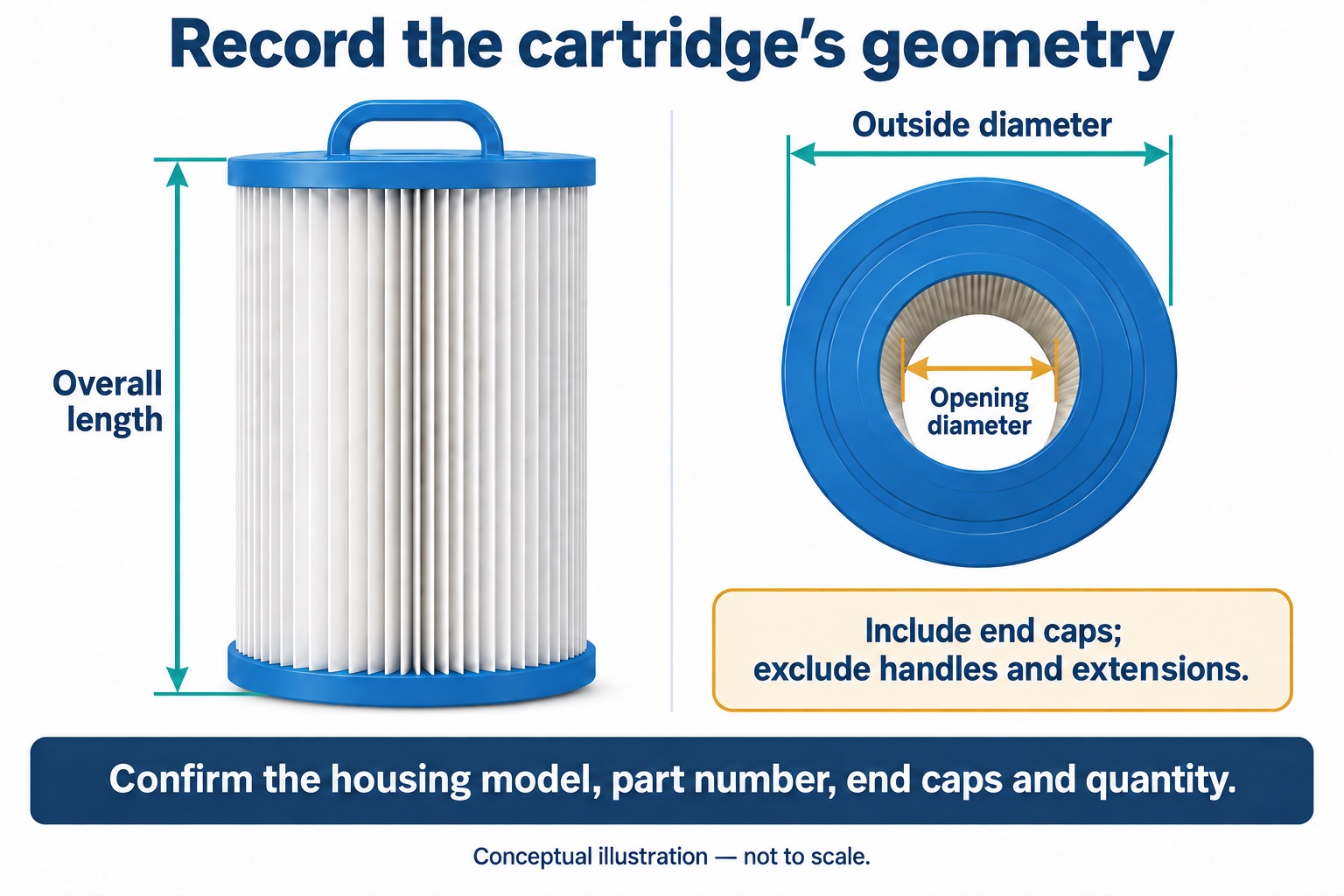
Unicel’s 2026 replacement guide specifies outside diameter to within 1/32 inch, overall length to within 1/16 inch, and open-end inside diameters to within 1/32 inch. Length includes the end caps but excludes handles or extensions. Note whether each end is open, closed, threaded, or otherwise shaped; do not substitute a photograph for these details.
Measure without forcing or compressing the element. Write fractions exactly rather than rounding to a familiar whole inch. If a worn end cap is distorted or the dimensions disagree with the catalog, flag the discrepancy for the supplier. Do not trim, stretch, or modify a replacement to make it fit.
Worked example: one system, four separate elements
Pentair’s Clean & Clear Plus range includes 240, 320, 420, and 520-square-foot systems. The following part mapping is from the manufacturer’s parts sheet—not a statement that the elements are interchangeable.
| System filtration area | Listed element part | Quantity required |
|---|---|---|
| 240 sq ft | R173572 | 4 |
| 320 sq ft | R173573 | 4 |
| 420 sq ft | R173576 | 4 |
| 520 sq ft | R173578 | 4 |
The Pentair parts sheet includes a post-November-1998 note for the listed 420/520 elements. Older equipment, revised parts, or superseded numbers require confirmation rather than assuming the table covers every tank ever sold.
For a CCP320 example, the 320-square-foot figure describes the complete filter, not each of its four elements. Pentair’s Pleatco replacement catalog lists PCC80-PAK4 for that application: a four-pack with 7-inch diameter, 20 1/16-inch length, and 3-inch openings at both ends. Check the current listing and housing identification before ordering. An offer for one element is not the same purchase as the four-pack.
Why dimensions are necessary but not sufficient
The same Pleatco catalog lists PAP75 for Clean & Clear 75 and PAP100 for Clean & Clear 100. Both show 10 1/16-inch diameter, 16 1/8-inch length, and 6-inch openings. Their matching dimensions do not erase the different application and media-area designations.
This is the practical decision rule: use measurements to catch an obvious mismatch, then use the documented model/part cross-reference to confirm the intended application. Neither “same size” nor “same brand” is a complete compatibility check. If a seller claims a universal substitute, ask for the specific cross-reference supporting your housing model.
A four-check worksheet before you order
- Housing identity: manufacturer ______; full model ______; area ______; manufacturing/serial detail ______.
- Documented replacement: OEM element number ______; parts-sheet revision or link ______; replacement brand/SKU ______; application confirmed by ______.
- Physical match: outside diameter ______; overall length excluding handle/extension ______; top configuration/opening ______; bottom configuration/opening ______.
- Purchase quantity: elements in the housing ______; elements supplied in this listing ______; single element or complete kit ______.
Keep a fifth note for anything unresolved: an illegible label, an older tank, damaged measurement surfaces, or a supplier’s superseded-part claim. Send the supplier the label photograph and worksheet and ask for written confirmation. An incomplete worksheet is a reason to pause, not to choose the nearest-looking cartridge.
Common ordering errors this process prevents
- Ordering a whole filter instead of an element: check what the listing actually supplies.
- Reading system area as individual-element area: separate housing capacity from each element’s specification.
- Ignoring end caps: the correct length does not compensate for the wrong opening or thread.
- Assuming an old installed element proves compatibility: previous owners can fit an incorrect part. Verify against the housing documentation.
- Confusing replacement with an upgrade: changing tank capacity, plumbing, or pump compatibility is a system-design decision, not a cartridge substitution.
How this guide was prepared: TemperatureMaster Editorial used AI-assisted research and writing, checked the examples against manufacturer catalogs, and developed the identification worksheet. We did not install or test these cartridges or obtain a pool-technician review. Catalog examples are not a fit guarantee; verify your specific equipment with its manufacturer or qualified supplier.
