
A pool pump circulates water through the filtration and treatment system. Selecting one requires more than comparing horsepower: the pump must work with the pool volume, plumbing, filter, required flow, electrical supply, and operating conditions.
How this guide was prepared: This is a research-based comparison, not a record of hands-on product testing. We reviewed published model specifications, installation requirements, warranty and support information, energy-efficiency factors, and pool compatibility. Product availability, specifications, warranties, and prices can change, so confirm them with the manufacturer or an authorized seller before purchase.
The main part of this guide explains pump selection and compares several solar-powered pump models. A separate supplemental section discusses electric pool heaters. A pump circulates water; a heater changes water temperature. They are different systems and must be sized independently.
Before buying or installing: Verify the pool volume, desired turnover, total dynamic head, pipe and union sizes, the filter’s maximum flow, voltage and circuit requirements, local electrical and building codes, and the manufacturer’s installation instructions. A qualified pool professional or licensed electrician should handle work involving mains electricity or uncertain system sizing.
Different Types Of Pool Pumps
Residential pool pumps are commonly sold as single-speed or variable-speed models. Variable-speed pumps can be programmed for different tasks and lower-flow operation. ENERGY STAR explains that matching speed to the task can reduce wasted energy, while the U.S. Department of Energy sets efficiency standards for dedicated-purpose pool pump motors.
| Aspects | Single-Speed Pool Pump | Variable-Speed Pool Pump |
| Energy efficiency | Less efficient | More efficient |
| Energy consumption | Consumes more energy | Consumes less energy at lower speeds |
| Operational cost | Higher operational costs due to constant high speed | Lower operational cost due to variable speed |
| Performance | Operates at a single, fixed speed | Adjustable speed for different tasks (filtration, heating, etc.). |
| Noise level | Produces more noise due to constant high speed | Comparatively quieter, especially at lower speeds |
| Customization | Limited, as you can not adjust the pump speed | Offers flexibility in adjusting pump speed to meet specific pool needs |
| Installation cost | Lower upfront cost | Higher up-front cost, but will save you money on maintenance and bills over time |
| Environmental impact | Less environmentally friendly due to higher energy consumption | More ecologically friendly due to energy savings |
| Suitable for | Basic pool systems with minimal customization needs | Energy-conscious pool owners looking to optimize pool operation |
Efficiency depends on the complete installation and operating schedule—not the speed label alone. See the official ENERGY STAR pool pump guidance and U.S. Department of Energy pool pump motor information.
Factors to Consider Before Buying a Pool Pump
Use the following checks to narrow the options. Do not choose by horsepower alone; the required flow depends on the pool and plumbing system.
- Pool volume and target flow: Determine the pool’s water volume and the flow needed for filtration, sanitation equipment, water features, and any other connected equipment.
- System resistance: Pipe length and diameter, fittings, elevation, filter condition, and other equipment affect total dynamic head. Compare the calculated requirement with the manufacturer’s pump curve.
- Speed control: A variable-speed model can match flow to different tasks. The potential savings depend on correct programming and the needs of the overall system.
- Noise: Compare manufacturer sound data when available, and consider installation location, vibration isolation, ventilation, and local noise rules.
- Efficiency: Check current ENERGY STAR certification where applicable and compare the model’s weighted energy factor and operating schedule—not only its motor wattage.
- Controls and compatibility: Confirm timers, automation support, freeze protection, voltage, pipe connections, saltwater compatibility, and whether a separate controller is required.
- Total cost: Consider purchase price, professional installation, required electrical or plumbing changes, expected energy use, replacement parts, warranty terms, and service availability.
Solar Pool Pump Models Compared
Solar-powered pool pumps can reduce grid electricity use, but their performance depends on solar-panel sizing, available sunlight, controller design, required flow, and total dynamic head. The models below were selected for comparison from published specifications and retailer/manufacturer information; they were not hands-on tested by Temperature Master.
- Happybuy Solar Swimming Pool Pump
- PWS Solar Powered Swimming Pool Pump
- Vevor Solar Pool Pump
Comparison criteria
We compared the following published factors. Inclusion is not a guarantee of performance or suitability for a particular pool:
- Energy efficiency
- Advanced features
- Durability
- Customer reviews
- Cost-effectiveness
- Reliability
- Happybuy Solar Swimming Pool Pump
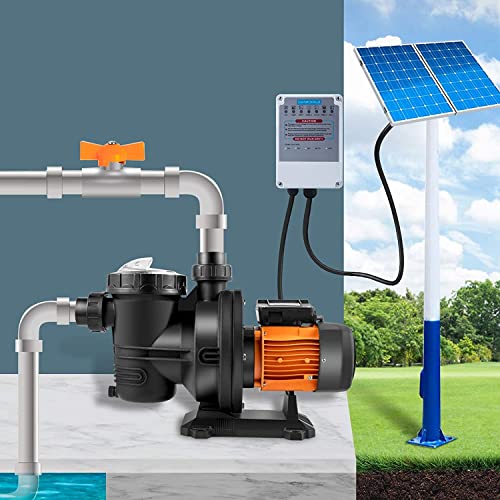
The Happybuy Solar Swimming Pool Pump is listed as a 72V DC solar-compatible circulation pump. Verify the current model number, pump curve, controller and panel requirements, certification, warranty, and saltwater compatibility before purchase.
This pump’s powerful 1,200W DC motor circulates water with low noise. Its advanced design includes a large detachable filter barrel for effortless maintenance and a transparent lid for easy monitoring of the filtration process. Moreover, this pump offers energy savings and is suitable for in-ground pools.

Key Features:
- This solar pool pump has a 1,200W DC motor, ensuring optimal flow rates while operating quietly.
- You can easily detach the large filter basket, ensuring easy cleaning and a clean pool environment.
- The pump is compatible with solar panels.
- It comes in a package with a controller, cables, and a plastic wrench for seamless setup and operation.
- The pump suits swimming pools, thermal springs, irrigation systems, and fishponds.
| Specifications | Details |
| Price | Check current retailer pricing |
| Model | JP31-19/1200 |
| Power | 1,200W |
| Voltage | 72V DC |
| Weight | 55 lbs/25 kg |
| Horsepower | 1.6HP |
| Solar panel compatibility | Suitable for 6pcs x 300W 30V solar panels |
Potential advantages based on published specifications
- Energy efficient
- Low noise
- Easy maintenance
- Durable build
Limitations to verify before buying
- Parts are not easily replaceable.
- May face difficulty in priming and creating suction.
- Vevor Solar Pool Pump
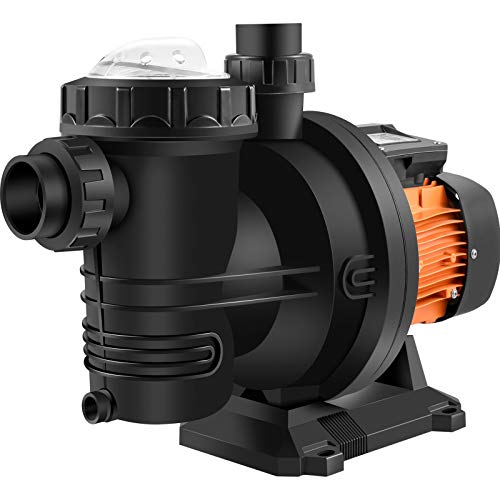
The Vevor Solar Pool Pump also utilizes solar power to ensure fast water circulation while reducing energy costs. This pool pump is a valuable addition to any pool setup and is ideal for in-ground pools, thermal springs, and fish ponds.
Key Features:
- It has a powerful 900W stainless motor and an advanced impeller design, producing optimal flow with reduced noise.
- The user-friendly design includes a detachable large filter barrel for effortless cleaning and maintaining a hygienic pool environment.
- This pump is suitable for saltwater.
- It is compatible with solar panels, which results in energy savings.
- It has a package with a controller, cables, and a plastic wrench, simplifying setup and operation.
| Specifications | Details |
| Price | Check current retailer pricing |
| Power | 900W |
| Voltage | 72VDC |
| Weight | 39.6lbs/18 kg |
| Dimensions | 22.8×5.1×13.3 in/58x13x34 cm |
| Gallons per minute | Up to 92GPM |
| Style | Above ground |
Potential advantages based on published specifications
- Suitable for saltwater
- Durable and corrosion-resistant construction
- It comes with all the necessary pieces of equipment.
- Low-noise operation
- Easy to maintain
Limitations to verify before buying
- The pump might not circulate the water effectively if you run it on low settings (1800GPH)
- PWS Solar-Powered Swimming Pool Pump
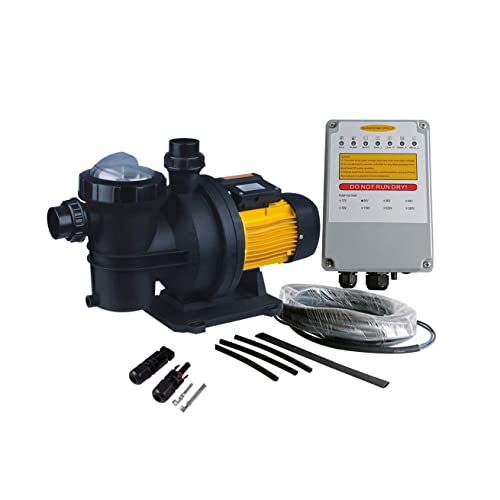
The PWS Solar-Powered Swimming Pool Pump is listed as a 48V DC model with an MPPT controller. Confirm the current specification sheet and required solar-array configuration before purchase.
Key Features:
- This 3/4HP, 48v DC solar-powered pool pump has an excellent 75GPM flow rate and can lift water to 49ft. Its durable build is suitable for home and industrial use, even in saltwater environments.
- It has a strong BLDC motor that ensures high efficiency and minimizes noise for a quieter operation and longer lifespan.
- The listing describes the pump as rated at 500W. Follow only the manufacturer’s current controller, voltage, wiring, and solar-array instructions; do not infer panel configuration from wattage alone.
- The pump’s controller employs Maximum Power Point Tracking (MPPT) technology, optimizing its efficiency even under varying light conditions. This ensures the pump operates at full speed, even with fewer solar panels.
| Specifications | Details |
| Price | Check current retailer pricing |
| Color | Black |
| Material | Stainless steel |
| Style | Above-ground |
| Power source | Solar-powered |
| Maximum flow rate | 75 Gallons Per Minute |
| Voltage | 48 Volts |
Potential advantages based on published specifications
- Durable build suitable for various uses, including saltwater environments.
- High-efficiency BLDC motor for optimal performance
- Easy maintenance with a detachable filter barrel and transparent lid
- Innovative MPPT controller for maximum flow under changing light conditions
- 3-year warranty and responsive customer support
Limitations to verify before buying
- Slightly higher upfront cost due to advanced technology
Electric Pool Heaters: A Separate Comparison
This section is supplemental because pool heaters and circulation pumps perform different jobs. Heater selection depends on pool volume and surface area, desired temperature rise, climate, heat loss, electrical capacity, installation location, and local code. The products below were compared from published specifications and were not hands-on tested by Temperature Master.
The following products represent different electric-heating approaches and capacity ranges. Verify the exact current model and have the installation requirements reviewed by a qualified professional.
- Hayward Heat Pro
- FibroPool Swimming Pool Heat Pump
- Ecosmart US Smart Pool Tankless Pool Heater
Comparison criteria
We considered the following published factors; inclusion does not mean that one model is suitable for every pool:
- Pricing
- Customer rating
- Heating capacity
- Warranty
- Compatible pool type
- Advanced features
- Energy-efficiency.
- Easy installation
- Hayward Heat Pro
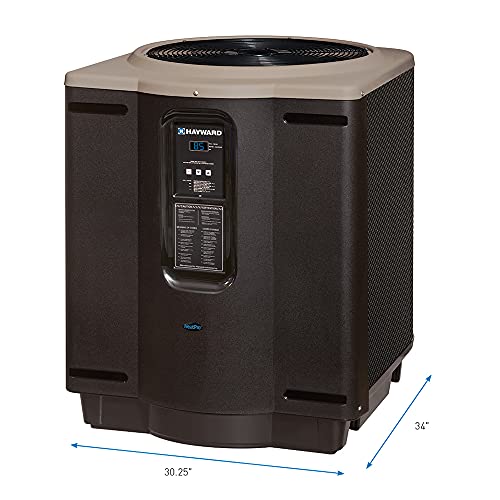
The Hayward HeatPro is a full-size pool heat pump. Confirm the exact model and its current performance data in the AHRI Directory, as well as the manufacturer’s sizing and installation requirements.
AHRI certification data can help compare independently verified performance ratings for a specific model. Certification does not replace correct sizing or installation.
Key Features:
- Full-sized electric heat pump perfect for in-ground and above-ground pools of up to 20,000 gallons.
- 90,000 BTUs of heating power
- Can withstand coastal environments with Ultra Gold corrosion-resistant technology.
- Extra-quiet fan for peaceful backyard enjoyment.
- The electric pool heater has a titanium heat exchanger, which is resistant to salty air and water corrosion and ensures exceptional durability.
Potential advantages based on published specifications
- Titanium exchanger ensures durability and corrosion resistance.
- Energy-efficient performance for maintaining ideal water temperature.
- Quiet operation enhances the backyard experience.
- Ultra Gold evaporator fin for extra durability.
Limitations to verify before buying
- Short two-year warranty.
- Higher price compared to competitors.
- FibroPool Swimming Pool Heat Pump
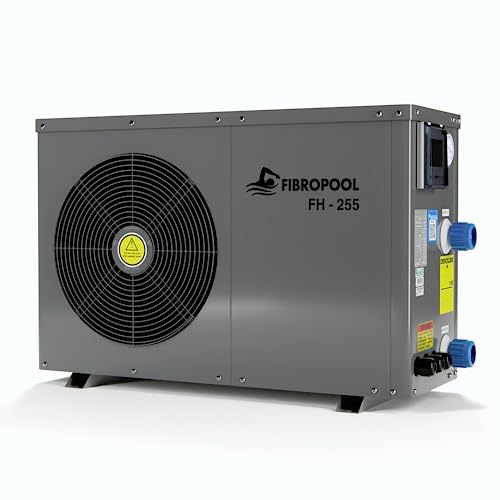
The FibroPool FH055 Swimming Pool Heat Pump is marketed for smaller pools. Capacity and efficiency decline as outdoor conditions change, so confirm the manufacturer’s current sizing chart, minimum operating temperature, electrical requirements, and warranty.
Key Features:
- Operates at 220 volts
- Provides 55,000 BTUs of warmth
- Compatible with above-ground pools up to 13,500 gallons
- Suitable for inground pools under 10,000 gallons
- Offers robust heating performance.
- Advanced compressors and titanium heat exchangers for optimal energy efficiency.
- It can endure outdoor elements with an enamel-coated steel chassis.
- Has a user-friendly digital control panel for convenient temperature setting and monitoring.
- It boasts a slim profile and flexible mounting options.
Potential advantages based on published specifications
- Efficient operation using less electricity
- User-friendly digital control panel
- Eco-friendly and cost-effective alternative
Limitations to verify before buying
- The functioning may decline when the external temperature drops below 50 degrees Fahrenheit.
- Ecosmart US SMART POOL Tankless Pool Heater
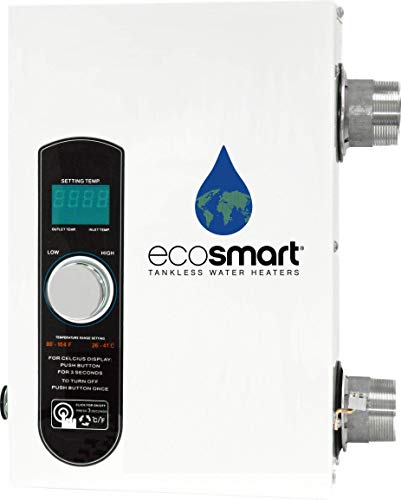
The EcoSmart SMART POOL 18 Electric Tankless Pool Heater is an electric resistance heater marketed for stand-alone or booster use. Verify the current manual, indoor-location requirements, required service capacity, breaker and conductor sizing, and local code before purchase.
It offers precise digital temperature control and is compatible with above-ground pools and spas. Moreover, it has flow sensors and comes with a limited warranty.
Key Features:
- Digital thermostat enables precise temperature adjustments.
- Tankless design delivering 92,128 BTUs of heating power on demand.
- Can warm an 11,000-gallon pool by up to 1.5°F per hour.
- Utilizes advanced flow sensor technology, enhancing reliability and durability.
- This electric pool heater is for indoor installation only, needing three 40-amp circuit breakers.
Potential advantages based on published specifications
- Provides precise and customizable temperature control.
- Versatile dual-functionality as a stand-alone heater or booster.
- Efficient heating capability with impressive BTU output.
- Compatible with various pool types.
Limitations to verify before buying
- Needs indoor installation due to a lack of weatherproofing.
- Requires three dedicated circuit breakers, which could affect installation cost and space.
Conclusion
Start with system requirements, not a product ranking. Calculate the needed flow and head, check the filter and plumbing limits, confirm voltage and controls, and compare pump curves and current efficiency data. For a heater, complete a separate heat-loss and electrical-capacity assessment. When the sizing or wiring is uncertain, use a qualified pool professional and licensed electrician.
FAQs
1. What is the average lifespan of pool pumps?
There is no guaranteed service life. It varies with model quality, run time, water chemistry, ventilation, installation, maintenance, freeze exposure, and operating conditions. Use the manufacturer’s maintenance schedule and investigate leaks, bearing noise, overheating, or repeated breaker trips promptly.
2. How much energy does an electric pool heater consume?
There is no useful universal wattage. Electric resistance heaters may draw many kilowatts, while heat pumps have different input and output ratings that change with conditions. Use the specific model’s nameplate input, current specification sheet, expected run time, local electricity rate, and climate to estimate consumption.
3. Are solar pool pumps suitable for all types of swimming pools?
No. Suitability depends on required flow and head, pool and plumbing design, sunlight, panel and controller sizing, voltage, climate, certifications, and compatibility with the filter and sanitation equipment. Confirm the full system design rather than relying on an above-ground or in-ground label.
4. What are the benefits of using a swimming pool heat pump over other heating options?
Heat pumps transfer heat from outdoor air to the water and can be efficient in suitable conditions. Actual capacity and efficiency depend strongly on air temperature, humidity, water temperature, sizing, installation, and use of a pool cover. Compare certified performance for the exact model and obtain a site-specific operating-cost estimate.
Sources and Update Notes
This article was reviewed for sourcing, product-testing transparency, and safety language on September 16, 2026. Product specifications and availability should still be verified before purchase.
- ENERGY STAR: Pool Pumps
- ENERGY STAR: Key Product Criteria for Pool Pumps
- U.S. Department of Energy: Dedicated-Purpose Pool Pump Motors
- AHRI Directory of Certified Product Performance
