
Glass bakeware can break from sudden temperature changes or damage even when a recipe uses an ordinary oven temperature. “Oven-safe” is permission for specified conditions, not a guarantee that the dish tolerates every heating mode, surface or temperature transition.
Check the exact dish and lid instructions before cooking. This guide concerns removable bakeware, not oven-door glass. A cracked oven pane is an appliance-service issue and should not be treated using cookware advice.
Before preheating: identify the dish and the lid
Find the manufacturer’s instructions for the actual item, including regional or product-family differences. A brand name, letter style, memory of a similar bowl or the fact that it survived a previous bake is not a complete use specification. Check whether the lid has different limits from the glass vessel.
Make a short record with four fields: exact product, permitted heating modes, lid restrictions and damage/discard criteria. Keep a photograph of the label or packaging. If the intended use cannot be confirmed, choose another clearly approved pan rather than testing the uncertain piece with food and heat.
Understand what thermal shock does—and does not tell you
A rapid, uneven temperature change can put stress into glass. That can occur during handling as well as inside an appliance. You cannot establish a safe transition simply by subtracting the kitchen temperature from the oven setpoint; glass type, geometry, damage and the way heat reaches it matter.
Pyrex’s safety and usage instructions address sudden temperature changes and damage, including avoiding added liquid in hot glassware and contact with wet or cool surfaces. They also distinguish glass vessels from lids. Apply those instructions to the covered product, not as proof that another brand or material has identical limits.
Use the intended oven mode
Pyrex’s FAQ requires a fully preheated conventional or convection oven for its described glass bakeware and prohibits direct heat such as a stovetop or broiler. Preheat is not interchangeable with broiling, and ordinary Bake approval does not extend to every countertop, air-fryer or combination appliance.
Do not infer a universal maximum temperature from a generic “glass” label. Use the exact product restrictions and recipe. Microwave suitability is a different question; our container-and-lid checklist explains why appliance modes need separate approval.
Prepare the landing place before the dish is hot
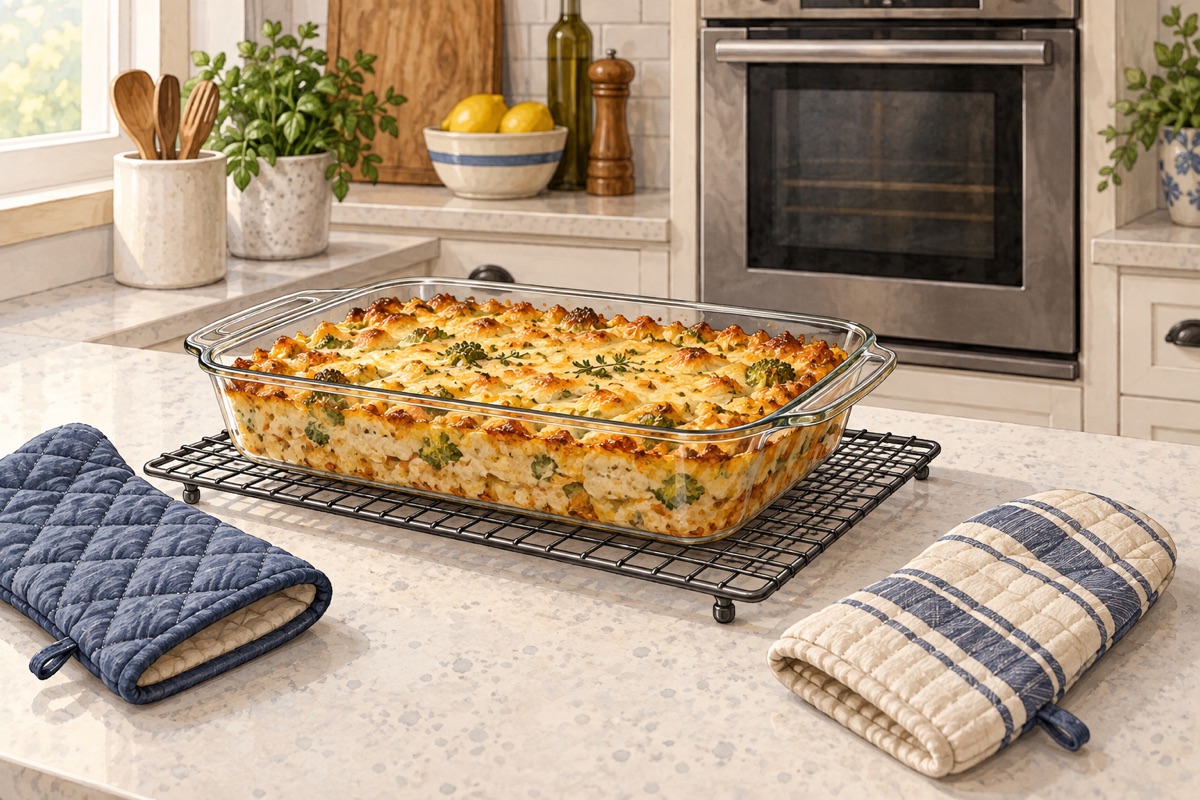
Plan the route from the oven to the permitted resting surface while everything is cool. Clear children, pets, clutter and wet items from that route. Have dry handling protection ready and use the resting arrangement specified by the maker; the illustration shows a conceptual cooling rack, not a universal rack recommendation.
Think through the next action too. Will somebody add cold sauce to the hot dish, put it in the sink or move it straight to cold storage? Check those steps against its care instructions before starting. A successful removal from the oven does not make the later transition harmless.
For example, a recipe’s final browning stage may call for a broiler. If the selected glassware prohibits it, completing the earlier Bake stage successfully does not approve the final stage. Choose a recipe and cookware combination whose whole sequence is permitted. Do not improvise a hot-food transfer while handling an unsuitable dish.
Stop for damage; do not attempt a home proof test
Inspect the cool dish safely without running fingers over a suspected crack or sharp edge. Follow its maker’s rules for chips, cracks, severe scratching, impact and other damage. Do not repair cooking glass with household glue, grind away damage or run it empty in an oven to prove it will survive.
If it breaks, keep people clear and avoid handling hot fragments. Follow the manufacturer’s cleanup guidance when it is safe to do so; use appropriate protection because pieces may be sharp and scattered. Do not serve food potentially contaminated with glass or try to establish safety by picking out visible fragments.
Keep baking performance separate from cookware safety
Pan size, depth, material and oven placement can change browning and timing. Use our rack-position and bakeware comparison guide for an otherwise normally operating oven—but only with approved, undamaged cookware. A desired browning pattern never overrides the dish’s safety restrictions.
Editorial method: TemperatureMaster Editorial prepared this research-based guide with AI-assisted research and writing checked against the linked primary publications. Examples and comparison aids are not hands-on test results or a professional diagnosis. Illustration generated with AI. See our editorial policy.
