
Before switching a pool sanitizer system, ask the seller to describe the complete treatment plan in writing. “Salt,” “UV” and “ozone” describe different processes; they do not by themselves tell you what disinfectant remains in the pool, how you will test it, or what happens when the equipment stops.
This guide is for evaluating residential swimming-pool proposals, not for converting chemical systems yourself. It does not cover small drain-and-refill kiddie pools or prescribe a hot-tub treatment program.
Start with the reason you want to change
Write down the specific problem: carrying chemical containers, unpredictable test results, service workload, recurring irritation, or unsupported advertising about “chemical-free” water. Different problems need different answers. A chlorine generator may change delivery convenience without eliminating chlorine; another device may add maintenance rather than reduce it.
If swimmers experience irritation, do not diagnose its cause from the smell of the water or assume another sanitizer is medically suitable. Check the pool’s operation with a qualified professional and seek appropriate medical advice for symptoms. Do not lower sanitation simply to change how the water feels.
Ask what protects the water between treatment passes
Pentair’s sanitation overview explains that a salt chlorine generator produces chlorine and describes UV used alongside chlorine generation. Salt chlorination is therefore not a chlorine-free alternative. Equipment at the pad and a measurable disinfectant in the pool are separate parts of the proposal.
UV or ozone should not be sold as a universal permission to stop maintaining a suitable residual disinfectant. Ask exactly what the installed system requires in the body of water. CDC’s public-facility guidance identifies UV and ozone as secondary disinfection in its operating context. That is useful context, not a residential installation code or a prescription for your pool.
Send this comparison sheet to each installer
| Question | Evidence to request |
|---|---|
| What is the complete treatment system? | Exact product and device models, primary disinfectant and supplementary stages |
| What will I measure in the pool? | Named test method, required operating ranges and testing frequency from applicable instructions |
| What conditions limit operation? | Specified flow, temperature and water-balance conditions; documented fault behavior |
| Is it compatible with my installation? | Written confirmation for the pool finish, heater, filter, pipework and other installed equipment |
| Who handles a conversion? | A product-specific professional plan for existing chemicals and any required changes |
| What happens after a failure? | Stop-swimming criteria, service contact and approved interim treatment procedure |
| What costs recur? | Testing supplies, consumables, cleaning, replacement parts and labor, itemized separately |
An answer such as “the controller does everything” leaves a gap. Ask which readings it actually measures and which still require a manual test. An output percentage or an illuminated status light is not itself a disinfectant concentration.
Compare work and costs over the same period
Use the same operating season and service scope for every proposal. Put acquisition and installation in one column; list annual testing, service, consumables and possible component renewal separately. Do not give one option a five-year total and compare it with another option’s purchase price.
For example, a quote that includes professional testing visits cannot fairly be compared with a hardware-only quote until you add an equivalent service allowance. An unspecified replacement interval should stay marked “not provided,” not become a predicted lifetime. This is a comparison method, not a claim that one technology is cheapest.
Keep ordinary sanitation checks after installation
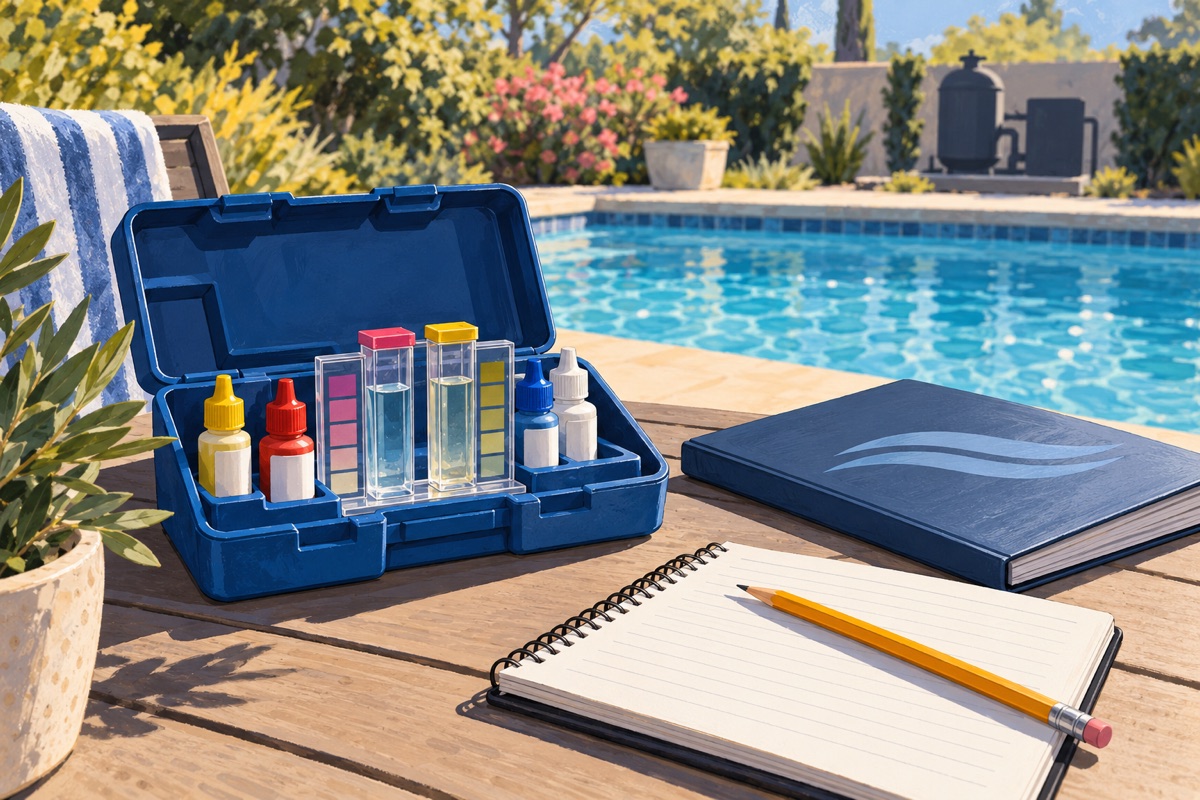
For chlorine or bromine systems, CDC’s pool guidance emphasizes measured disinfectant and pH, testing at least twice daily and more often with heavy use, while following product instructions. Clear water and lack of odor do not replace those checks. Use the instructions applicable to the selected treatment; a chlorine kit does not automatically assess a different sanitizer.
Never pour an alternative product into an existing system to “try it.” Chemical compatibility, conversion and disposal need exact label instructions and professional advice. Do not mix products or bypass flow switches and other safeguards.
Make the decision only when the gaps are answered
A satisfactory proposal identifies the protection in the pool, the checks you perform, compatibility and who acts when something fails. Keep that document with the manuals. For the separate daily routine, our saltwater maintenance guide covers testing and cell care; our corrected chlorine-alternatives overview explains why supplemental treatment is not equivalent to replacing the primary sanitizer.
Editorial method and limits
TemperatureMaster Editorial prepared this research-based guide with AI-assisted research and writing checked against the primary publications linked in the text. Examples and planning aids are editorial constructions, not results from hands-on testing or a professional inspection. The illustration is AI-generated. See our editorial policy.
