
Uneven browning is not automatically evidence of a failed oven thermostat. Rack position, bakeware, loading and the selected mode can change results even when the oven heats. Use the recipe and exact oven instructions as your starting point, then change one permitted variable at a time and keep a simple record.
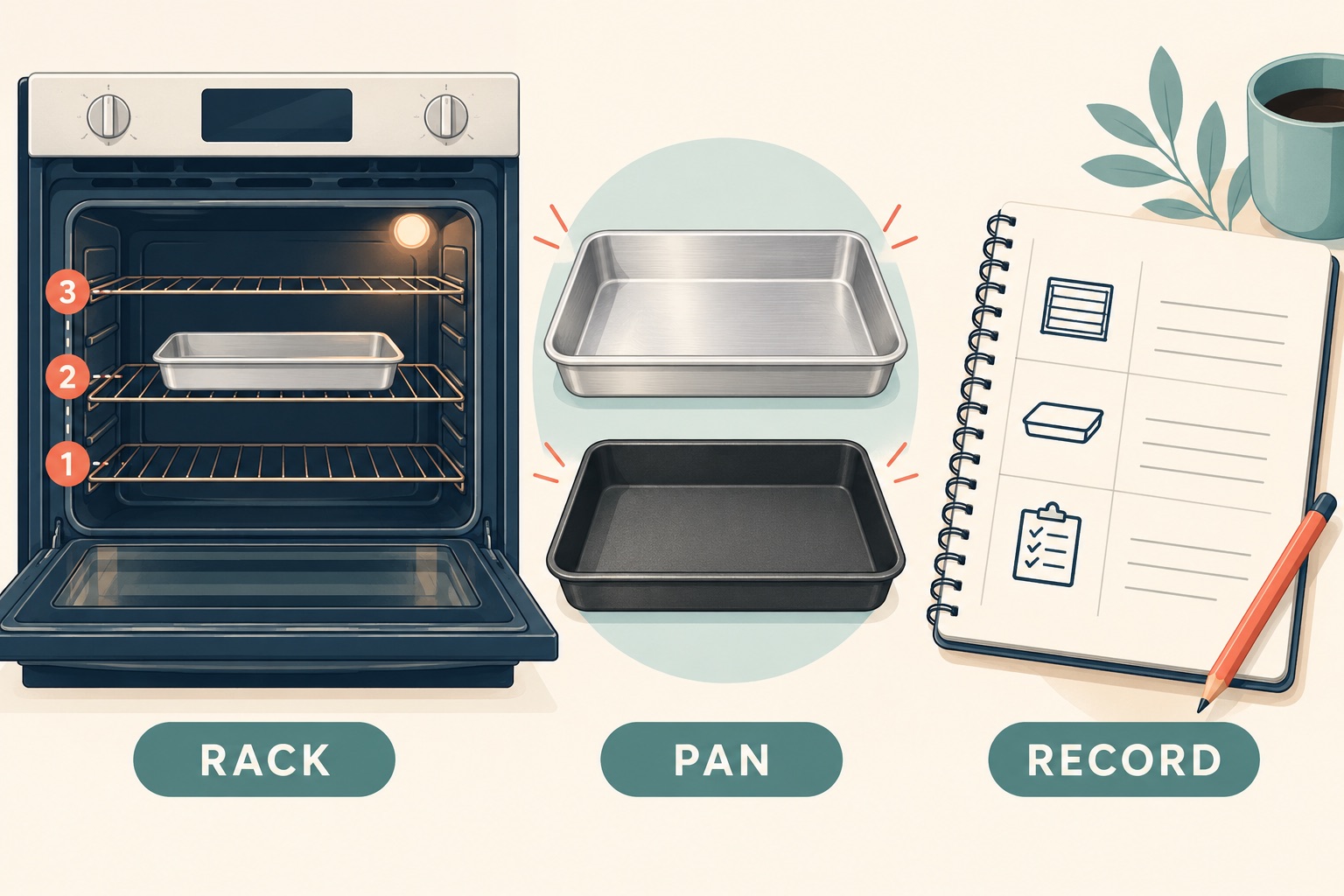
First establish that this is a baking-result problem
This comparison is for an otherwise normally operating oven. If it does not heat, displays an error, overheats, trips protection or produces smoke or sparks, do not conduct baking experiments. Use our Maytag oven not-heating guide or the applicable model’s service guidance. For gas odors or a carbon-monoxide alarm, leave the area and contact the gas utility or emergency services from safety.
Different recipes legitimately use different positions, pans and temperatures. Do not convert a generic illustration of a center rack into a universal instruction for every oven or dish.
Separate rack placement from bakeware
Maytag’s uneven-baking guidance identifies preheating, pan characteristics and placement as factors. Dark or dull bakeware absorbs heat differently from shiny bakeware; opening the door repeatedly loses heat. Follow the recipe, pan maker and oven manual instead of applying a universal temperature adjustment to every dark pan.
Its bottom-browning guidance also warns against foil lining that obstructs heat and airflow. Keep the oven bottom and an entire rack free of improvised foil coverings. Place pans and multiple racks only as the exact instructions permit.
Describe the result before changing settings
| Observation | Information worth recording | Do not conclude yet |
|---|---|---|
| Top darker than bottom | Rack position, pan finish, mode and preheat completion | That the lower element has failed |
| One side darker | Pan orientation, number of pans and spacing | That the oven needs calibration |
| Outside browned; center underdone | Recipe, portion depth, pan size, temperature and cooking time | That browning proves the food is fully cooked |
| Results changed after switching pans | Material, finish, dimensions and recipe adjustments | That only the pan color changed |
Photos help when they show the whole batch rather than only the darkest item. Note what changed since the last acceptable bake: a deeper pan, two racks instead of one, or a switch from Bake to Convection can be more informative than the word “uneven.”
A practical one-variable comparison
Choose a familiar recipe and an approved pan. Keep the recipe, quantity and pan size consistent. Position racks while the oven is cool. Complete the model’s required preheat, use the recipe’s starting instructions and cook food to its appropriate safe endpoint; this is not a reason to taste raw dough or undercooked food.
- Record the first bake without making several speculative changes.
- Select one change allowed by the manual and recipe—for example, a different recommended rack position while keeping the same pan.
- Repeat on a comparable occasion, keeping mode, loading and recipe consistent.
- Compare the pattern, not just a single spot. Stop if abnormal appliance behavior appears.
If changing pans next, acknowledge any unavoidable changes in dimensions or recipe directions. A comparison with multiple differences cannot isolate the effect of finish alone. It can still help you choose a more repeatable setup, but it is not a controlled product test.
Keep an oven-and-pan record
| Field | Your entry |
|---|---|
| Recipe and batch | Source, quantity and portion size |
| Oven | Model, selected mode, temperature and any automatic conversion |
| Placement | Rack position using the manual’s numbering, pan count and orientation |
| Bakeware | Material, finish, internal dimensions and maker restrictions |
| Outcome | Cooking time, browning pattern and appropriate doneness check |
Do not assume that Convection Bake uses the same settings as ordinary Bake. Some appliances apply automatic temperature conversion; record what the controls actually did. Avoid calibration or installer-menu changes while comparing pan placement, because they introduce another variable.
When to involve support
Persistent poor results using the correct manual and recipe setup, unexplained temperature behavior or an error code merits manufacturer support or a qualified technician. Give them the record and photos rather than replacing parts based on browning alone. Our GE oven shutoff guide is useful for that different symptom; it is not a substitute for Maytag instructions.
Editorial method: TemperatureMaster Editorial used AI-assisted research and writing. This original comparison framework draws on Maytag owner guidance; it is not a laboratory oven test, technician inspection or calibration procedure. Sources checked October 4, 2026. See our editorial policy.
